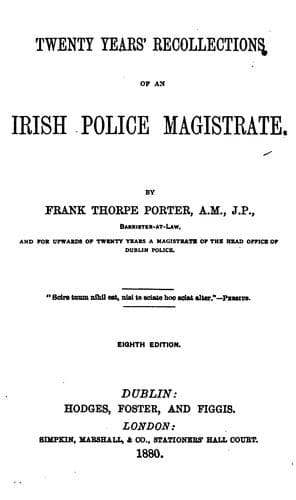
Twenty Years' Recollections of an Irish Police MagistratePorter, Frank Thorpe
History
Twenty Years' Recollections of an Irish Police Magistrate
Porter, Frank Thorpe
Crime -- Ireland; Criminals -- Ireland; Ireland -- Social life and customs; Porter, Frank Thorpe, 1801-1882
credited, refuse to sympathize with a parent whose helplessness
compelled him to witness, with unavailing anguish, the poignant
miseries of the offspring he had hoped, by his honest exertions, to have
supported and reared, without submitting to the galling necessity of
soliciting that aid which nothing but the most absolute destitution
could reconcile him to implore. A _military lady_ announced herself as
the widow of color-sergeant Robert Maffett, who having served faithfully
for twenty-three years, the four last having been in India, had been
severely wounded in a decisive battle in Scinde, and when invalided and
pensioned, was unfortunately drowned at Blackwall, in consequence of the
boat which was conveying him ashore being accidentally upset. That she
and her eight poor orphans had no resource on reaching her native city,
where she found that all her relations had died or emigrated, and where
she was friendless and alone, but to throw herself upon the charitable
feelings of one whose character emboldened her to hope that the humble
appeal of the soldier's widow, for herself and her poor orphans, would
not be unavailing. These and a thousand other _slums_ were manufactured
in Bridgefoot Street, alias Dirty Lane, not an unsuitable name for the
locale of such proceedings, and they were invariably accompanied by
lists of subscriptions, and magisterial or municipal attestations,
admirably got up in the first style of forgery. In the first case to
which I have adverted, the "hapless widow" succeeded in getting five
pounds from the Lord Chief Justice of Ireland (Pennefather). In the
instance of the "military widow," Lady Blakeney was lightened of three
pounds. Another _slum_ was circulated by a scoundrel who represented
himself to be the son of a gentleman in the south of Ireland, of an old
family, and of the pristine faith; that he had been educated at Louvain,
had an ardent wish to become a Catholic clergyman, and that one of the
most distinguished dignitaries of that church was inclined to ordain
him, but his father had died in debt, without leaving him the means of
providing even the most humble outfit for such a vocation. One of his
missives produced the effect of relieving an alderman's lady of five
pounds sterling, which the excellent and worthy matron piously
suggested might be useful in providing the embryo priest _with
vestments_.
This confederacy was not confined to Dublin. Its branches extended
through Leinster, Connaught, Munster, and in almost every important town
in England its connections were established. It is, however, very
curious that the Scots and our Northern countrymen were left
comparatively free from its attacks. Why? Is it because the rascally
crew conceived the natives of Scotland and Ulster to be more cautious or
less benevolent than their respective Southern neighbours? The reader
may judge for himself; but swindlers are not, in general, very wrong in
their estimate of character or disposition.
Public-domain text, read in full here on John Shaqi.
Reviews
Reviews
No reviews yet
Be the first to share your thoughts on this work.
Elsewhere in the archive
Join the Discussion
Join the discussion
Sign in to leave a comment or review.
Sign InorCreate an account