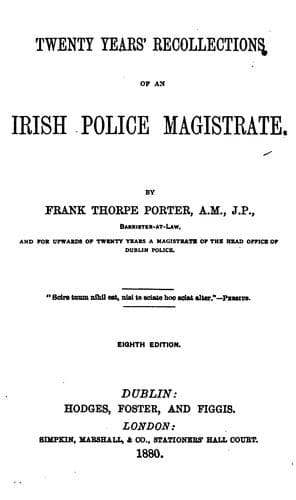
Twenty Years' Recollections of an Irish Police MagistratePorter, Frank Thorpe
History
Twenty Years' Recollections of an Irish Police Magistrate
Porter, Frank Thorpe
Crime -- Ireland; Criminals -- Ireland; Ireland -- Social life and customs; Porter, Frank Thorpe, 1801-1882
vociferating to me, that if her enemy was not sent off to Grangegorman
_at wanst_, her life and her child's life (for she was _enceinte_) would
be lost. "But what did she say?" was my query. "What did she say! yer
worship, what did she say! Why she came down _forenenst the whole world
at the corner of Plunket Street_, and called me 'a b----y ould
excommunicated gasometer.'" I may mention that as female invective
generally ascribed inconsistency to its opponent, so the male
scolds--happily not very numerous--had their favorite term of reproach;
and when they wished to destroy a man's reputation, they designated
him--a thief?--no; a robber?--no; a murderer?--no; they satiated all
their malignity in calling him "an informer."
Disputes between manufacturers and their artisans or workmen were very
rarely the subject of magisterial investigation. There was, however, one
case disposed of by me in which a comparison was instituted of a most
extraordinary nature. A journeyman summoned an employer for abruptly
dismissing him, without giving him, according to the usage of the trade,
"a week's notice or a week's wages." I shall not mention the name,
residence, or trade of the defendant: but I must say that his
countenance exhibited the greatest obliquity of vision that I ever
observed in a human face. All the trite phrases commonly applied to
squints would fail adequately to describe the tendency of his eyes to
avoid seeing the same object at the same time. He admitted having
summarily discharged the workman, and alleged that the complainant had
totally spoiled an article which he had been directed to make in a
hexagon form, and conformable to a pattern supplied, and had produced a
piece of work in which shape and proportion had been totally
disregarded. The complainant insisted that the work had been properly
done, and in complete conformity with the model, and he asked why it was
not produced, so that I might judge, by viewing it, whether it deserved
to be condemned as crooked and shapeless. I suggested a postponement of
the case, and the production of the condemned article. The defendant,
who was rather excited, replied, "Your worship, I was so vexed when it
was brought in, that I threw it out of the window of the finishing room
into the yard, and it was smashed to pieces, but I am ready to swear, in
this or any other court, that _it was as crooked as the two eyes in my
head_." The laugh in which I indulged, at hearing this comparison, was
lost in the risibility of all present. I suggested that the parties
might come to an understanding, and that the complainant might be
afforded another opportunity of making an article perfectly conformable
to the pattern, and without any resemblance _to anything else_. This was
agreed to, and they departed reconciled.
CHAPTER XIII.
DOGS--WHIPPING YOUNG THIEVES--GARDEN ROBBERS--REFORMATORIES--APOLOGIES
FOR VIOLENCE--TRESPASSERS ON A NUNNERY.
Public-domain text, read in full here on John Shaqi.
Reviews
Reviews
No reviews yet
Be the first to share your thoughts on this work.
Elsewhere in the archive
Join the Discussion
Join the discussion
Sign in to leave a comment or review.
Sign InorCreate an account