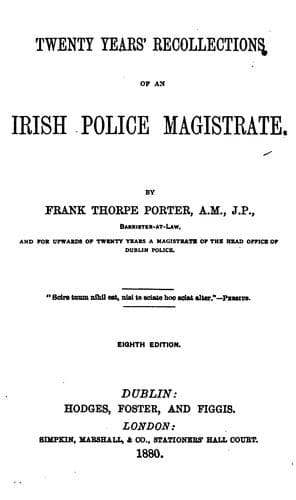
Twenty Years' Recollections of an Irish Police MagistratePorter, Frank Thorpe
History
Twenty Years' Recollections of an Irish Police Magistrate
Porter, Frank Thorpe
Crime -- Ireland; Criminals -- Ireland; Ireland -- Social life and customs; Porter, Frank Thorpe, 1801-1882
I may mention that being in London in 1849, on official business, I was
invited to dine at the Mansion House at an entertainment given by the
Lord Mayor of that year (Sir James Duke) to the judicial authorities,
metropolitan magistrates, &c. I had the honour to sit beside Chief Baron
Pollok, and in conversation with him and two or three others in my
proximity, I narrated the preceding anecdote. He said that the apology
tendered to me was not more ridiculous or absurd than one which had been
offered by some of those engaged in the "No Popery" riots of 1780,
connected with the name of Lord George Gordon. There was a house in
Charles Street, from the precincts of which morality was totally
estranged, and it was thoroughly devastated by a furious mob. Some of
those concerned in wrecking it were subsequently arrested, tried and
convicted of the offence. When brought forward for sentence, the judge
gave them to understand that the reputation of the premises afforded no
justification for their violence, nor could it be alleged in mitigation
of their punishment. Two or three of them exclaimed, "that if they had
known what the house really was, they would never have attacked it; but
they had been told, and fully believed, that it was _a Nunnery_."
TRESPASSERS ON A NUNNERY.
In twelve or eighteen months after the festive occasion to which I have
referred, I accompanied a friend to visit two of his daughters, who were
pupils at the Loretto Convent, Rathfarnham. Mrs. Ball, the aged and
respected Superioress, gave us a very kind reception. We were conducted
through the gardens and conservatories. On returning to the house, we
were plentifully served with refreshments. In the course of
conversation, my friend expressed his regret that so much hostile
feeling should exist against conventual institutions. I remarked that it
was not at all so intense as it had been in the previous century, when
in London the mere reputation of a house being a nunnery was considered
by the populace as fully sufficient to justify its destruction. To the
best of my recollection, the Superioress observed--"I hope that those
who entertained such hostile feelings lived long enough to repent of
them. I think that the various classes of society are coming to a better
understanding, and I expect great progressive improvement. Here we have
not suffered the slightest annoyance for more than thirty years, and the
only matter of which we had to complain was not very serious. Shortly
after this establishment was founded, two young fellows, who resided in
the neighbourhood, formed a design to entice two very handsome and rich
young ladies to elope with them. They provided ladders, climbed into the
trees which overhung the wall, dropped notes at the feet of the lasses,
and were for a time incessant in their amatory pursuit. However, a
communication with the guardian of one and the parents of the other, and
the consequent authoritative expostulations, produced a satisfactory
effect.
Public-domain text, read in full here on John Shaqi.
Reviews
Reviews
No reviews yet
Be the first to share your thoughts on this work.
Elsewhere in the archive
Join the Discussion
Join the discussion
Sign in to leave a comment or review.
Sign InorCreate an account