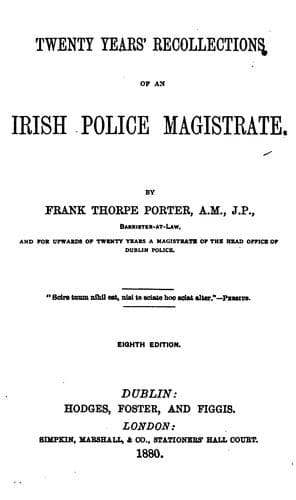
Twenty Years' Recollections of an Irish Police MagistratePorter, Frank Thorpe
History
Twenty Years' Recollections of an Irish Police Magistrate
Porter, Frank Thorpe
Crime -- Ireland; Criminals -- Ireland; Ireland -- Social life and customs; Porter, Frank Thorpe, 1801-1882
The committee admitted the applicant, registered the admission, and
brought the case before the Board of Guardians on the following
Thursday, when they obtained a ready sanction to prosecute Mr. Gilmore
for deserting his wife, and leaving her, as a pauper, chargeable on the
rates. A summons bearing my signature issued, and the constabulary
officer appeared at the police-court. The marriage was proved, as were
the circumstances of the desertion. On the part of the Guardians a
demand was made for the immediate committal of the delinquent, to be
imprisoned, with hard labor for three months. Richard Gilmore escaped a
formal conviction by paying the expenses already incurred, and
undertaking to allow twenty shillings weekly for his wife's maintenance.
All parties left the police-court; but in an hour or two after the case
had been heard, Richard Gilmore returned and applied to me to have
Elizabeth Jones, calling herself Gilmore, apprehended on a charge of
bigamy. He alleged that she had been married in Wales about four years
previous to her marriage with him, and that her husband, Thomas Jones,
was still living. His assertions were made on statements which he had
received from others. He had no legal evidence of the charge, and I
refused to issue a warrant for the apprehension of the alleged bigamist,
but he determined to persist in the accusation. He seized on his wife in
the public street, and gave her into the custody of a constable on a
charge of felony. On the following morning he stated on oath that he had
been informed, and fully believed, that the prisoner had been married to
one Thomas Jones in a parish church near Carnarvon; that said Thomas was
still living; and he further swore to the marriage of the prisoner with
himself in the city of Dublin. He asked for a remand, and stated that he
expected to produce witnesses from Wales to prove his charge. I remanded
the accused for six days, and Richard left Dublin by the next Holyhead
packet in quest of evidence to convict his wife. Before she was removed
to prison she sent to me a short note, in which she implored me to
direct that no person should be permitted to see her in the prison
unless at her own request; and further, that on the day for resuming the
investigation, she should be placed amongst a number of females, and
that the witnesses should be required to identify her from amongst the
others. I considered those requests to be fair and reasonable, and
directed that they should be complied with. Richard Gilmore returned to
Dublin the day before the resumption of the case. He brought over two
witnesses, and sought at the prison to give them a view of the accused,
but they were denied admittance. On the appointed day Elizabeth Gilmore
was brought from the prison, and placed in the carriage-court with about
a dozen of other females, amongst whom was Mrs. Canavan, her Nicholas
Street landlady, who manifested great interest in her sufferings, and
Public-domain text, read in full here on John Shaqi.
Reviews
Reviews
No reviews yet
Be the first to share your thoughts on this work.
Elsewhere in the archive
Join the Discussion
Join the discussion
Sign in to leave a comment or review.
Sign InorCreate an account