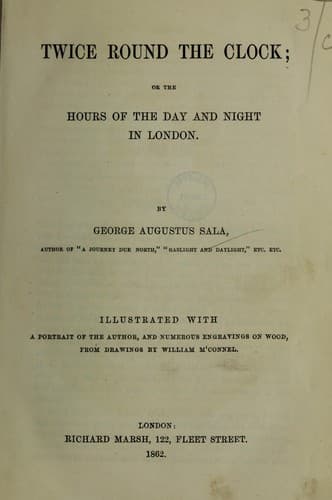
Twice round the clock; or, The hours of the day and night in LondonSala, George Augustus
General
Twice round the clock; or, The hours of the day and night in London
Sala, George Augustus
London (England) -- Social life and customs -- 19th century
tattered and torn, who have never studied the “Handbook to Etiquette,”
nor heard of Burke and Debrett, and who would eat peas with their knives
if they had any peas to eat—Heaven help them! They are around and about
you always. I have no greed of gain in advocating their cause, for I am
unknown to them, and am of your middle class, and am as liable to be
stoned by the ragged ones for having a better coat than they any day. But
woe be to you, respectables, if you shut your ears to their plaints and
your eyes to their condition. For the stones may fly thick and fast some
day; there may be none to help you, and it may be too late to cry for
help.
I have heard Regent Street compared to the Boulevard des Italiens, to
Unter-den-Linden at Berlin, to Broadway at New York, to the Montagne
de la Cour at Brussels, to the Corso de’ Servi at Milan, to the Toledo
at Naples, to George Street, Sydney, and to the Nevskoi Perspective at
Petersburg. In my opinion, Regent Street is an amalgamation of all these
streets, and surpasses them all. Their elements are strained, filtered,
refined, condensed, sublimated, to make up one glorious thoroughfare.
Add to this, the unique and almost indescribable _cachet_ which the
presence of English aristocracy lends to every place it chooses for
its frequentation, and the result is Regent Street. Of the many cities
I have wandered into and about, there is but one possessing a street
that can challenge comparison with—and that, I must confess, well nigh
equals—the street that Nash, prince of architects, built for the fourth
George. At a right angle from the pleasant waters of the river Liffey,
there runs a street, wide in dimensions, magnificent in the proportions
of its edifices, splendid in its temples and its palaces, though many of
the latter, alas! are converted now into hotels, now into linen-drapers’
shops; but on a golden summer’s afternoon, when you see, speeding towards
the column of Nelson in the distance, the glittering equipages of the
rich and noble, who yet have their dwelling in Eblana; the clattering
orderlies, on sleek-groomed horses, and with burnished accoutrements,
spurring from the Castle towards the Post Office—and, beauty of beauties,
the side walks on either hand converted into parterres of living flowers,
the grand and glorious Irish girls, with their bright raiment and
brighter eyes; you will acknowledge that Regent Street has a rival, that
beyond St. George’s Channel is a street that the triumphal procession of
a Zenobia or a Semiramis might pass down, and that the queen of streets
is Sackville Street, Dublin.
Public-domain text, read in full here on John Shaqi.
Reviews
Reviews
No reviews yet
Be the first to share your thoughts on this work.
Elsewhere in the archive
Join the Discussion
Join the discussion
Sign in to leave a comment or review.
Sign InorCreate an account