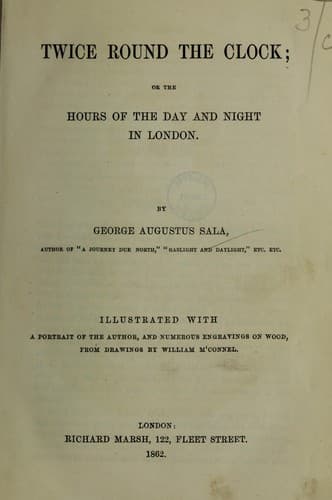
Twice round the clock; or, The hours of the day and night in LondonSala, George Augustus
General
Twice round the clock; or, The hours of the day and night in London
Sala, George Augustus
London (England) -- Social life and customs -- 19th century
There are some here, who are dissatisfied with the bargains they have
made, and are squabbling in a lively manner on the foot pavement. Mark,
I entreat you, among them, those dusky-faced females, mostly given to
the loose and flabby order of corpulency, who are shabbily dressed,
yet with a certain tendency to the wearing of lace bonnets, and faded
cashmeres, and who have moreover a decided penchant for golden bangles
and earrings, and rings with large stones that do not shine. You cannot
make up your mind at once that they are Jewesses, because they have a
conflicting facial resemblance to Gipsies. During the sale they have been
reclining, not to say squatting, on the broad goods counter in shabby
state, like second-hand sultanas, making bids in deep contralto voices,
or mysteriously transmitting them through the intermediary of glib Jew
boys with curly heads. These commercial females must be reckoned among
the million and one mysteries of London. I imagine them to be the ladies
dwelling in remote suburbs or genteel neighbourhoods gone to decay, who,
in the columns of the “Times,” are always expressing a desire to purchase
second-hand wearing apparel, lace, jewellery, and books, for the purpose
of exportation to Australia, and for which they are always willing to
pay ready money, even to the extent of remitting post-office orders in
immediate return for parcels from the country. They, too, I think, must
keep the mysterious “ladies’ wardrobe shops” known to the Abigails in
aristocratic families, and which are, a little bird has told me, not
altogether unknown to the patrician occupants of the noblest mansions
of the realm. Thus, there seems to be a perpetual round of mutation and
transmutation going on among clothes. The natural theory of reproduction
here seems carried to its most elaborate condition of practice; and,
bidding adieu to Debenham and Storr’s, the chaffering Jews, and the
dusky ladies’ wardrobe women, my mind wanders to Rag Fair, thence to
the emporium of Messrs. Moses and Son, and thence, again, to Stultze,
Nugee, and Buckmaster, and I end in a maze of cogitation upon the “Sartor
Resartus” of Thomas Carlyle.
Public-domain text, read in full here on John Shaqi.
Reviews
Reviews
No reviews yet
Be the first to share your thoughts on this work.
Elsewhere in the archive
Join the Discussion
Join the discussion
Sign in to leave a comment or review.
Sign InorCreate an account