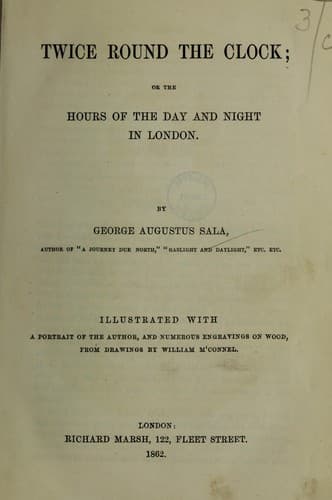
Twice round the clock; or, The hours of the day and night in LondonSala, George Augustus
General
Twice round the clock; or, The hours of the day and night in London
Sala, George Augustus
London (England) -- Social life and customs -- 19th century
I am not aware whether any of my present generation of readers—people
are born, and live and die, so fast now-a-days—remember a friend of
mine who dwelt in an out-of-the-way place called Tatty-boy’s Rents, and
whom I introduced to the public by the name of Fripanelli. He was a
music-master—very old, and poor, and ugly; almost a dwarf in stature,
wrinkled, decrepit; he wore a short cloak, and the boys called him
“Jocko;” indeed, he was not at all unlike a baboon in general appearance.
But Fripanelli in his time—a very long time ago—though now brought
to living in a back slum, and teaching the daughters of chandlers’
shopkeepers, had been a famous professor of the tuneful art. He knew old
Gaddi—Queen Caroline’s Gaddi—well: he had been judged worthy to preside
at the pianoforte at Velluti’s musical classes; and he had even written
the music to a ballet, which was performed with great _éclat_ at the
King’s Theatre, and in which the celebrated Gambalonga had danced. To
me, Frip. had an additional claim to be regarded with something like
curiosity mingled with reverence; for he had positively been, in the
halcyon days of youth, the manager of an Italian opera company, the place
of whose performance was—wherever do you think?—the Pantheon, in Oxford
Street. Now, as I stand in the lively bazaar, with the prattling little
children, and the fine flounced ladies, I try to conjure back the days
when Fripanelli was young, and when the Pantheon was a theatre. From here
in the vestibule—where the ornamented flower-pots, and the garden-chairs
of complicated construction, and the busts with smoky cheeks and noses,
and marvellously clubbed heads of hair, have their _locus standi_—from
here sprang the grand staircase. There was no Haydon’s picture of Lazarus
for our grandfathers and grandmothers in hoops and powder—you must
remember that Fripanelli looks at least two hundred and fifty years of
age, and is currently reported to be ninety—to stare at as they trotted
up the degrees. Yonder, in the haven of bygone mediocrities in the
picture-gallery, may have been the crush-room; the rotunda at the back
of the bazaar, where now the vases of wax-flowers glimmer in a perpetual
twilight, must have been the green-room; the conservatories were
dressing-rooms, and the stage door was undoubtedly in Great Marlborough
Street. How I should have liked to witness the old pigtail operas and
ballets performed at the Pantheon, when Fripanelli and the century were
young. “Iphigenia in Aulis,” “Ariadne in Naxos,” “Orestes and Pylades,”
“Daphnis and Chloë,” “Bellerophon,” “Eurydice,” the “Clemency of Titus,”
the “Misfortunes of Darius,” and the “Cruelty of Nero”—these were the
lively subjects which our grandfathers and grandmothers delighted to have
set to Italian music. Plenty of good heavy choruses, tinkle-tankling
instrumental music, plaintive ditties, with accompaniments on the fife
and the fiddle, and lengthy screeds of droning recitatives, like the
Public-domain text, read in full here on John Shaqi.
Reviews
Reviews
No reviews yet
Be the first to share your thoughts on this work.
Elsewhere in the archive
Join the Discussion
Join the discussion
Sign in to leave a comment or review.
Sign InorCreate an account