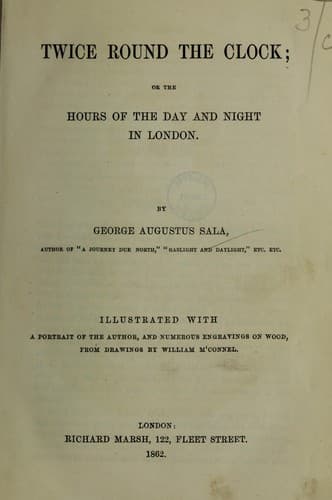
Twice round the clock; or, The hours of the day and night in LondonSala, George Augustus
General
Twice round the clock; or, The hours of the day and night in London
Sala, George Augustus
London (England) -- Social life and customs -- 19th century
In the memoirs of old Nollekens, the sculptor, you will find that he
was an assiduous frequenter of the Italian Opera at the Pantheon, to
which he had a life admission—it did not last _his_ life though, I am
afraid—and that he sat in the pit with his sword by his side, and a
worsted comforter round his neck. This must surely, however, have been
before the days of Fripanelli’s management. It is hard to say, indeed,
for the Pantheon has been so many things by turns and nothing long.
Once, if I mistake not, there was wont to be an exhibition of wax-work
here; once, too, it was famous as a place for masquerades of the most
fashionable, or, at least, of the costliest description. Here Charles Fox
and Lord Maldon, with dominoes thrown over their laced clothes, and masks
pressed upon their powdered perukes, reeled in from the chocolate houses
and the E. O. tables; here, so the legends say, the bad young prince, who
afterwards became a worse old king, the worthless and witless wearer of
the Prince of Wales’s three ostrich plumes—here George III.’s eldest born
met the beautiful Perdita. He ill-treated her, of course, afterwards,
as he ill-treated his wives (I say wives, in the plural number, do you
understand?) and his mistresses, his father, his friends, and the people
he was called upon to govern. He lied to, and betrayed, them all; and he
was _Dei gratiâ_, and died in the odour of civil list sanctity, and they
have erected a statue to his disreputable memory in Trafalgar Square.
Soft, whisper low, tread softly: the Pantheon was once a church! Yes,
there were pews in the area of the pit, and free-sittings in the
galleries. There is a singing, buffooning place in Paradise Street,
Liverpool, where they dance the Lancashire clog-hornpipe, yell comic
songs on donkeys’ backs, perform acrobatic feats, juggle, strum the
banjo, clank the bones, belabour the tambourine, stand on their heads,
and walk on the ceiling. This place is called the Colosseum, _but it was
once a chapel_. The pews, with very slight alteration, yet exist, and on
the ledges where the hymn-books were wont to lie, stand now the bottles
of Dublin stout and ginger-pop. I do not like these violent revolutions,
these galvanic contrasts. They are hideous, they are unnatural, they are
appalling. To return to the Pantheon—I still follow the legends—after it
had been a masquerading temple and a wax-work show, and then a church,
it was changed once more into a theatre; but _mark what followed_. One
Saturday night the company were playing “Don Giovanni,” and midnight had
struck before the awful tramp of the Commendatore was heard re-echoing
through the marble corridors of the libertine’s palace, and the last
tube of maccaroni stuck in Leporello’s throat; but when, the finale
being at its approach, and to cap the climax of the catastrophe, twelve
demons in flame-coloured garments, and bearing torches flaming with
resin, rose from trap-doors to seize the guilty Don, the manager, who
Public-domain text, read in full here on John Shaqi.
Reviews
Reviews
No reviews yet
Be the first to share your thoughts on this work.
Elsewhere in the archive
Join the Discussion
Join the discussion
Sign in to leave a comment or review.
Sign InorCreate an account