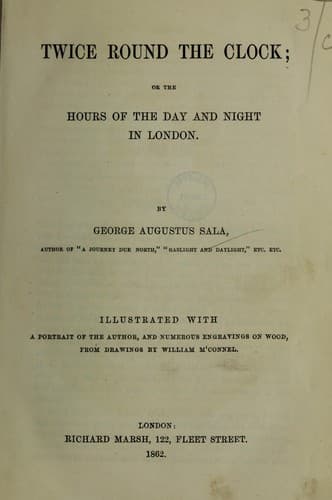
Twice round the clock; or, The hours of the day and night in LondonSala, George Augustus
General
Twice round the clock; or, The hours of the day and night in London
Sala, George Augustus
London (England) -- Social life and customs -- 19th century
was such a long time since, they were so young then—it was ever such a
long time ago. You silly little creatures! it was only the day before
yesterday, and the day after to-morrow——. But “gather ye rosebuds while
ye may,” and regard not old Time as he is a-flying. For my part, I will
mingle no drop of cynicism in the jewelled cup of your young enjoyment;
and I hope that the day after to-morrow, with unkind husbands and
ungrateful children, with physic-bottles and aches and pains, and debts
and duns, may never come to you, and that your pretty shadows may never
be less.
You see that I am in an unusual state of mansuetude, and feel for the
nonce inclined to say, “Bless everybody”—the Pope, the Pretender, the
Pantheon, the pretty girls, and the sailors’ pig-tails, though they’re
now cut off. Every sufferer from moral _podagra_ has such fits of
benevolence between the twinges of his gout. But the fit, alas! is
evanescent; and I have not been ten minutes in the conservatory of
the Pantheon before I begin to grumble again. I really must shut my
ears in self-defence against the atrocious, the intolerable screeching
of the parrots, the parroquettes, the cockatoos, and the macaws, who
are permitted to hang on by their wicked claws and the skin of their
malicious beaks to the perches round the fountain. The twittering of the
smaller birds is irritating enough to the nervously afflicted; but the
parrots! ugh! that piercing, long-continued, hoarse shriek—it is like a
signal of insane communication given by a patient at Hanwell to a brother
lunatic at Colney Hatch. The worst of these abominable birds is, that
they cannot or will not talk, and confine themselves to an inarticulate
gabble. However, I suppose the fairest rose must have its thorns, and the
milkiest white hind its patch of darker colour; so it is incumbent on us,
in all charity, to condone the ornithological nuisance which is the main
drawback to a very pretty and cheerful place of resort. Only, I should
like to know the people who buy the parrots, in order that I might avoid
them.
As we entered by Oxford Street, with its embeadled colonnade, it becomes
our bounden duty to quit the building by means of that portal which I
assumed to have been in days gone-by the stage-door of the pig-tail
opera-house, and which gives egress into Great Marlborough Street. I
can’t stand the parrots; so, leaving my aunt (I wish she would lend me
a hundred pounds), and my cousin (I wish she would lend me a kiss, and
more sincerely do I wish that either of them existed in the flesh, or
elsewhere but in my turbid imagination); leaving these shadowy relatives
genteelly bargaining (they have already purchased a _papier maché_
inkstand and a coral wafer-stamp), I slip through the conservatory’s
crystal precincts, inhale a farewell gust of flower-breeze, pass through
a waiting-room, where some tired ladies are resting till their carriages
draw up, and am genteelly bowed out by affable beadle No. 2.
Public-domain text, read in full here on John Shaqi.
Reviews
Reviews
No reviews yet
Be the first to share your thoughts on this work.
Elsewhere in the archive
Join the Discussion
Join the discussion
Sign in to leave a comment or review.
Sign InorCreate an account