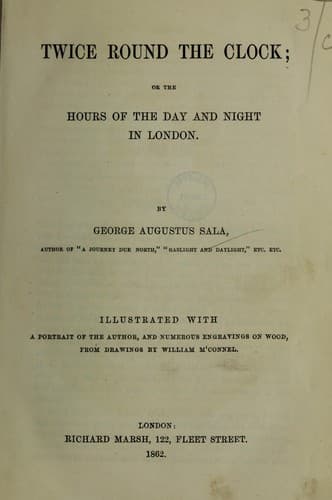
Twice round the clock; or, The hours of the day and night in LondonSala, George Augustus
General
Twice round the clock; or, The hours of the day and night in London
Sala, George Augustus
London (England) -- Social life and customs -- 19th century
When you arrive at a building called St. George’s School of Medicine, and
at the door of which, at most times of the day, you will find lounging
a knot of medical students, who should properly, I take it, in this
sporting locality, have a racing and “down-the-road” look, but who, on
the contrary, have the garb and demeanour of ordinary gentlemen—(What
has become of the old medical student whom Mr. Albert Smith used to
caricature for our amusement, with his shaggy overcoat, white hat, lank
hair, short thick stick, staring shawl, short pipe, and slangy manners
and conversation? Is he extinct as a type, or did he never exist, save in
the lively imagination of that popular writer, and whom I hope all good
luck will attend?)—When you have passed this edifice, sacred to Galen,
Celsus, Hippocrates, and the rest of the Faculty of Antiquity, it will
be time for you to turn down a narrow lane, very like one leading to an
ordinary livery-stable, and to find yourself suddenly in a conglomeration
of “corners.” At one corner stands a building with a varnished oak
door, that does not ill resemble a dissenting chapel with a genteel
congregation, and fronting this, screened from the _profanum vulgus_ by
a stout railing, sweeps round a gravelled walk, surrounding a shaven
grass-plat of circular form. This is the famous “Ring,” of which you have
heard so much; and the building that resembles a dissenting chapel is
none other than Messrs. Tattersall’s subscription rooms. Within those to
ordinary mortals unapproachable precincts, the privacy of which is kept
with as much severity as the interior of the Stock Exchange, the great
guns of the turf discharge their broadsides of bets. They do not always
confine themselves to the interior, however; but, when the weather is
fine and betting hot, particularly on settling days, when there is an
immense hubbub and excitement possessing every one connected with the
turf, from the smallest stable-boy up to Lords Derby and Zetland, they
come forth into the open, and bet round the grass plat. Now cast your
eyes to the right (you are standing with your back to Grosvenor Place),
and you will see a low archway, passing through which a hand points to
you the spot where Mr. Rarey, the horse-tamer, had his office; while
on the other side is a counting-house, somewhat dark and mysterious in
aspect, where the names and prices of more racers and hunters than you
or I ever heard of are entered in Tattersall’s bulky ledgers. Beyond the
archway stretches a spacious court-yard, the centre occupied by a species
of temple, circular in form, with painted wooden pillars and a cupola,
surmounted by a bust of George IV. Beneath the cupola is the figure of
a fox sedent and regardant, something like the dog of Alcibiades, and
looking, in troth, very cunning and foxy indeed. To the right, looking
from the archway, are stables, with a covered penthouse in front; to the
left, another archway, with more stables and coach-houses.
Public-domain text, read in full here on John Shaqi.
Reviews
Reviews
No reviews yet
Be the first to share your thoughts on this work.
Elsewhere in the archive
Join the Discussion
Join the discussion
Sign in to leave a comment or review.
Sign InorCreate an account