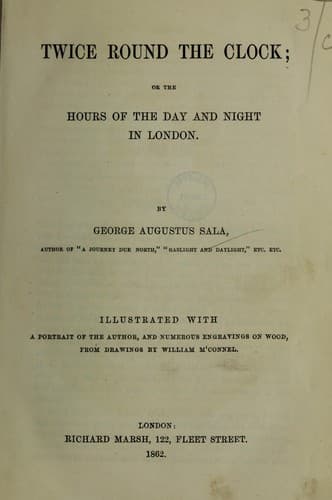
Twice round the clock; or, The hours of the day and night in LondonSala, George Augustus
General
Twice round the clock; or, The hours of the day and night in London
Sala, George Augustus
London (England) -- Social life and customs -- 19th century
The Danaës! the Amazons! the lady cavaliers! the horsewomen! can any
scene in the world equal Rotten Row at four in the afternoon, and in
the full tide of the season? Bois de Boulogne, Course at Calcutta,
Cascine at Florence, Prado at Madrid, Atmeidan at Constantinople—I
defy ye all. Rotten Row is a very Peri’s garden for beautiful women on
horseback. The Cliff at Brighton offers, to be sure, just as entrancing
a sight towards the end of December; but what is Brighton, after all,
but London-super-Mare? The sage Titmarsh has so christened it; and the
beauties of Rotten Row are transplanted annually to the vicinity of the
Chain Pier and Brill’s baths. Watch the sylphides as they fly or float
past in their ravishing riding-habits and intoxicatingly delightful hats:
some with the orthodox cylindrical beaver, with the flowing veil; others
with roguish little wide-awakes, or pertly cocked cavaliers’ hats and
green plumes. And as the joyous cavalcade streams past, (I count the male
riders absolutely for nothing, and do not deem them worthy of mention,
though there may be marquises among them) from time to time the naughty
wind will flutter the skirt of a habit, and display a tiny, coquettish,
brilliant little boot, with a military heel, and tightly strapped over it
the Amazonian riding trouser.
Only, from time to time, while you gaze upon these fair young daughters
of the aristocracy disporting themselves on their fleet coursers, you
may chance to have with you a grim town Diogenes, who has left his tub
for an airing in the park; and who, pointing with the finger of a hard
buckskin glove towards the graceful _écuyères_, will say: “Those are not
all countesses’ or earls’ daughters, my son. She on the bay, yonder,
is Laïs. Yonder goes Aspasia, with Jack Alcibiades on his black mare
Timon: see, they have stopped at the end of the ride to talk to Phryne
in her brougham. Some of those dashing delightful creatures have covered
themselves with shame, and their mothers with grief, and have brought
their fathers’ gray hair with sorrow to the grave. All is not gold that
glitters, my son.”
FIVE O’CLOCK P.M.—THE FASHIONABLE CLUB, AND THE PRISONERS’ VAN.
The English are the only “Clubable” people on the face of the earth.
Considering the vast number of clubs which are more or less understood
to flourish all over the Continent, and in the other hemisphere, it is
within possibility that I shall be accused of having uttered something
like a paradox; but I adhere to my dictum, and will approve it Truth. Not
but that, concerning paradoxes themselves, I may be of the opinion of Don
Basilio in the “Barber of Seville,” expressed with regard to calumny.
“Calumniate, calumniate,” says that learned casuist; “calumniate, and
still calumniate, _something will always come of it_.” So, in a long
course of paradoxes, it is hard but that you shall find a refreshing
admixture of veracity.
Public-domain text, read in full here on John Shaqi.
Reviews
Reviews
No reviews yet
Be the first to share your thoughts on this work.
Elsewhere in the archive
Join the Discussion
Join the discussion
Sign in to leave a comment or review.
Sign InorCreate an account