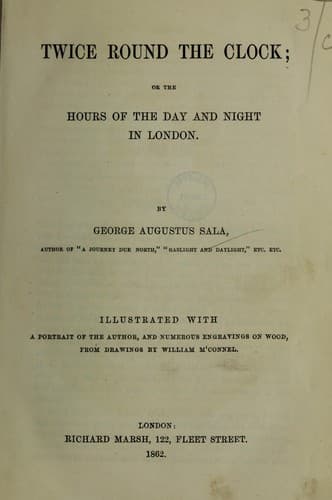
Twice round the clock; or, The hours of the day and night in LondonSala, George Augustus
General
Twice round the clock; or, The hours of the day and night in London
Sala, George Augustus
London (England) -- Social life and customs -- 19th century
The great complaint against clubs is, that they tend towards the
germination of selfishness, exclusiveness, and isolation; that they are
productive of neglect of home duties in married men, and of irrevocable
celibacy in bachelors. Reserving my own private opinion on this knotty
point, I may say that it is a subject for sincere congratulation that
there are no ladies’ clubs. We have been threatened with them sometimes,
but they have always been nipped in the bud. It is curious to see how
fiercely this tolerant, liberal, large-headed creature, Man, has waged
war against the slightest attempt to establish a club on the part of the
gentler sex. From the Parisian malecontents of the first revolution, who
broke into the lady assemblies of the _Jacobines_ and _Tricoteuses_, and
broke up the clubs in question by the very expeditious process of turning
the fair members into the street, after subjecting them to a castigation
whose use is ordinarily confined to the nursery; from those ungallant
anti-clubbists (they all belonged to clubs themselves, you may be sure)
to Mr. Mark Lemon, who, in a _petite comédie_, brought the guns of satire
to bear with terrible effect on an incipient agitation for lady clubbism,
such institutions, on the part of the ladies, have always been put down,
either by violence or by ridicule. The Tyrant Man is even, I am informed,
disposed to look with jealousy on the “committees of ladies” which
exist in connection with some deserving charities, and on the “Dorcas
societies” and “sewing circles” of provincial towns; and all meetings to
advocate the rights of woman, he utterly abhors.
I daresay that you would very much like to know the name of the
particular club, the tableau of which adorns this sheet, and would feel
obliged if I would point out the portraits of individual members: you
would be very much pleased to be told whether it is the Carlton, the
Reform, the Travellers’, the Athenæum, the Union, the United Service
Senior or Junior, the Guards, the Oriental, the Oxford and Cambridge, the
Parthenon, the Erectheum, the Wyndham, Whyte’s, Boodle’s, or the Army
and Navy. No, Fatima; no, Sister Anne. You shall not be told. Clubbism
is a great mystery, and its adepts must be cautious how they explain its
shibboleth to the outer barbarians. Men have been expelled from clubs ere
now for talking or writing about another member’s whiskers, about the cut
of his coat, and the manner in which he eats asparagus. I have no desire
for such club-ostracism; for though, Heaven help me, I am not of Pall
Mall or St. James’s, I, too, have a club whose institutes I revere. “_Non
me tua fervida terrent, dicta, Ferox_:” I fear not Jawkins, nor all the
Borekins in Borekindom; but “_Dii me terrent, et Jupiter hostis_:” I fear
the awful committee that, with a dread complacency, can unclub a man for
a few idle words inadvertently spoken, and blast his social position for
an act of harmless indiscretion.
Public-domain text, read in full here on John Shaqi.
Reviews
Reviews
No reviews yet
Be the first to share your thoughts on this work.
Elsewhere in the archive
Join the Discussion
Join the discussion
Sign in to leave a comment or review.
Sign InorCreate an account