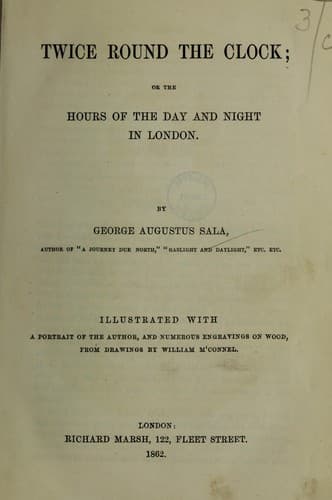
Twice round the clock; or, The hours of the day and night in LondonSala, George Augustus
General
Twice round the clock; or, The hours of the day and night in London
Sala, George Augustus
London (England) -- Social life and customs -- 19th century
This is again six o’clock p.m., but not by any means on the same evening.
The occasion could have no possible connection with going out to dinner,
for it happens to be six o’clock “sharp:” and, moreover, it is on Friday,
a day on which it is supposed to be as unlucky to go out to dinner as
to go to sea, to marry, to put on a new coat, to commence a new novel,
to cut your nails, or buy tripe. Now, what can I be doing in the city
on this Friday evening? Certainly not to perform any of the operations
alluded to above. Scarcely on business. Bank, Exchange, wharfs,
Custom-house, money-market, merchants’ counting-houses, are all closed,
and the inner city, the narrow winding lanes, that almost smell of money,
are deserted. What am I doing so close to St. Paul’s Cathedral, and why
do I turn off by St. Martin’s-le-Grand? For the simple reason, that
Friday evening is the very best one in the seven to witness the spectacle
I am going to see—Newspaper Fair at the General Post Office.
In the vast vestibule, or hall, of the establishment so admirably
presided over by Mr. Rowland Hill (for I do not reckon the aristocratic
placeman who is, turn and turn about, Whig or Tory, its nominal chief,
for much), and whose fostering care has made it (with some slight
occasional shortcomings) the best-managed and most efficient national
institution in Europe, you may observe, in the left-hand corner from
the peristyle, and opposite the secretary’s office (tremendous “counts”
are the clerks in the secretary’s office, jaunty bureaucrats, who ride
upon park hacks, and are “come for” by ringlets in broughams at closing
time, but who get through their work in about half the time it would
take the ordinary slaves of the desk, simply because their shrewdness
and knowledge of the world enables them to “see through a case” before
the average man of tape and quill can make up his mind to docket a
letter) a huge longitudinal slit in the panelling above, on which is the
inscription “For newspapers only.” And all day long, newspapers only,
stringed or labelled, are thrust into this incision; and the typographed
lucubrations of the some five hundred men who, for salaries ranging from
twenty shillings to twenty pounds per week, have to think, and sometimes
almost feel, in the Anglo-Saxon tongue, for some sixty millions of people
(I say nothing of the re-actionary influence upon foreign nations), go
forth to the uttermost ends of the earth. But as six o’clock approaches
(and six o’clock sharp is the irrevocable closing time for the departure
of newspapers by the current night’s mail), they open a tall window
above, and the newspapers are no more thrust, but flung in.
[Illustration: SIX O’CLOCK P.M.: THE NEWSPAPER WINDOW AT THE GENERAL
POST-OFFICE.]
Public-domain text, read in full here on John Shaqi.
Reviews
Reviews
No reviews yet
Be the first to share your thoughts on this work.
Elsewhere in the archive
Join the Discussion
Join the discussion
Sign in to leave a comment or review.
Sign InorCreate an account