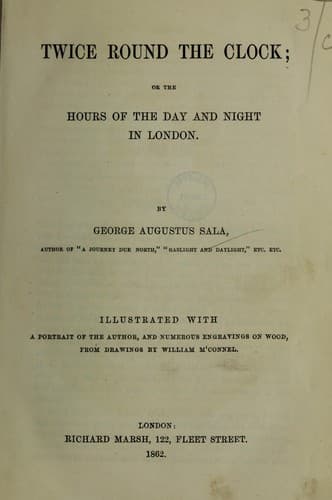
Twice round the clock; or, The hours of the day and night in LondonSala, George Augustus
General
Twice round the clock; or, The hours of the day and night in London
Sala, George Augustus
London (England) -- Social life and customs -- 19th century
What shall I assume the first piece that is to be performed this night
to be? Will you have the “Flowers of the Forest,” the “Poor Strollers,”
“Sweethearts and Wives,” “Pizarro,” the “Padlock,” or a “Game at
Romps?” What do you say to a fine old English comedy, such as “John
Bull,” or the “School of Reform,” with a dissipated young squire,
a gouty, ill-tempered, and over-bearing old lord of the manor, an
intensely-virtuous tenant-farmer, a comic ploughman, a milkmaid with a
chintz gown tucked through the placket-holes, and a song, and a spotless
but a persecuted maiden? No; you will have none of these! Suppose, then,
we take our dear old genial friend, the “Green Bushes”—long life and good
luck to Mr. Buckstone, and may he write many more pieces as good for our
imaginary theatre. See; the green-room clock points to ten minutes to
seven—I left that out in my inventory of the furniture. The call-boy has
already warned the ladies and gentlemen who are engaged for the first
scene, that their immediate presence is required, and the erst-deserted
green-room fills rapidly.
See, here they came—the kindly old friends of the “Green Bushes”—Miami
and Jack Gong, and Master Grinnidge; and yet, dear me, what are these
strange, wild costumes mingled with them? Oh! there is a burlesque after
the drama. It is somewhat early in the evening for those who are to play
in the second piece to come down dressed; but then you are to consider
this as a special green-room, a specimen green-room, an amalgam of the
green-room element generally. This model _foyer_ is to have something
of the Haymarket and something of the Adelphi—the old by-gone, defunct
Adelphi, I mean—a spice of the Olympic, a tinge of the Lyceum, and a
dash of the Princess’s, about it. I except the green-room of Drury Lane,
which never resembled anything half so much as a family vault, and
the green-rooms of the two Operas, which, though splendidly furnished
and appointed, are almost deserted during the performances, the great
_tenori_ and _soprani_ preferring to retire to their dressing-rooms when
any long intervals of rest occur.
“Things”—to use a bit of “Green Bushes” _facetiæ_, invented, I am willing
to believe, by that incorrigible humourist, Mr. Wright, and which has
grown proverbial—“things isn’t as they used to was;” and the attractions
of green-rooms have deteriorated, even within my time. When I say “my
time,” I mean a quarter of a century; for as I happened to be almost born
in a prompt-box and weaned in a scene-painter’s size-kettle, and have
been employed in very nearly every capacity in and about a theatre—save
that of an actor, which profession invincible modesty and incurable
incompetency prevented me from assuming—I feel myself qualified to speak
about the green-rooms with some degree of authority. To have read a
three-act melodrama to a (scarcely) admiring audience, and to have called
“everybody for the last scene” in a green-room, gives a man, I take it, a
right to be heard.
Public-domain text, read in full here on John Shaqi.
Reviews
Reviews
No reviews yet
Be the first to share your thoughts on this work.
Elsewhere in the archive
Join the Discussion
Join the discussion
Sign in to leave a comment or review.
Sign InorCreate an account