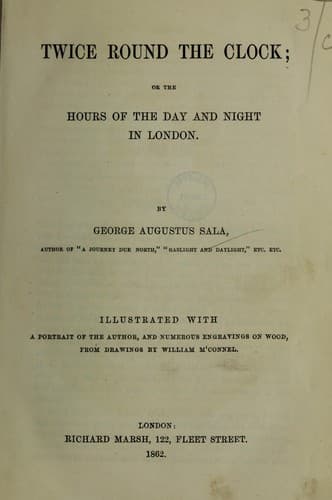
Twice round the clock; or, The hours of the day and night in LondonSala, George Augustus
General
Twice round the clock; or, The hours of the day and night in London
Sala, George Augustus
London (England) -- Social life and customs -- 19th century
Eleven o’clock: theatrical audiences are at their apogee, and the last
piece is “on.” Convivial clubs are in full action, and the waiters at the
supper-rooms, very tumbled and drowsy during the day, put on their most
highly-starched neckcloths, and begin to rub their eyes, in preparation
for the labours of the night. The linen-drapers’ shopmen, who have
been strolling about Regent Street and Oxford Street since the shops
closed at nine, and who “live on the premises,” begin to turn in; the
proprietors tolerate no gadding about after eleven, and persistence in
keeping bad hours to the extent of hearing the chimes at midnight, out of
doors, would entail reprimand, and perhaps expulsion, on the offender.
At eleven o’clock close the majority of the coffee, chop houses, and
reading-rooms. There are some that will remain open all night; but they
are not of the most reputable description. At eleven the cheap grocer,
the cheesemonger, and the linen-draper, in low-priced neighbourhoods,
begin to think of putting up the shutters; and, by half-past eleven, the
only symposia of merchandise open will be the taverns and cigar-shops,
the supper-rooms and shell-fish warehouses, the night coffee-houses, and
the chemists—which last shops, indeed, never seem to be quite open, or
quite closed, at all, and may be said to sleep with one eye open.
Eleven o’clock at the West-end is, morally speaking, broad day-light.
Midnight will be high noon. Fashionable life’s current riots through the
veins of West-end streets; mirth, and gaiety, and intrigue, are heard on
staircases and at street corners. And pre-eminently wide awake, busy,
active, and restless just now is the great and mysterious country of
Bohemia, both Upper and Lower. You are beginning to hear of Bohemia, oh,
reflective reader! and of its shady denizens. Recondite, half-reluctant
allusions are made to it in solemn reviews and portentous magazines. An
arch-Bohemian proposed the other day to write a novel concerning the
present condition of his country. The book actually appeared, but its
author stumbled on the threshold of his own subject. Either he dared not
say that which he knew, or he had over-estimated his knowledge of things
Bohemian: and he drew, not the real country, but an impalpable region
full of monsters. But his was no easy task. After all, who shall say, who
can tell, where Bohemia really is, and who really are Bohemians? They
are secretly affiliated, and to each other known, like freemasons, like
the Illuminati and Brethren of the Rosy Cross of the last century, like
Balzac’s “Treize;” but the outside world knows them not, and oft-times
mistakes for a Bohemian a vile Illyrian, a contemptible Styrian, a
worthless Croat, or a base Bezonian. Is there a king of Bohemia? or is
it an oligarchy, a theocracy, or a red republic? How does a man become
a Bohemian, and can he ever renounce his allegiance to the “friends of
Bohemia,” and become an ordinary citizen of the world? Yet Bohemianism is
Public-domain text, read in full here on John Shaqi.
Reviews
Reviews
No reviews yet
Be the first to share your thoughts on this work.
Elsewhere in the archive
Join the Discussion
Join the discussion
Sign in to leave a comment or review.
Sign InorCreate an account