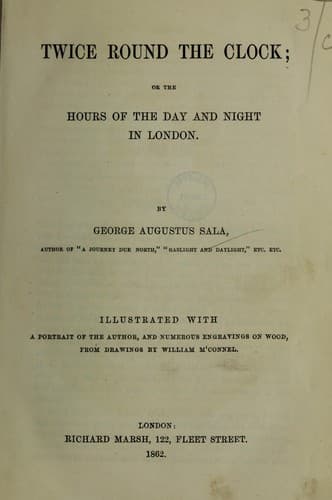
Twice round the clock; or, The hours of the day and night in LondonSala, George Augustus
General
Twice round the clock; or, The hours of the day and night in London
Sala, George Augustus
London (England) -- Social life and customs -- 19th century
The lions of literature are present in the flesh. Here is the
distinguished Snortup, author of “The Common Objects of the Back-yard,”
“Geology in Joke,” “Trigonometry Judged by Taxation,” “The Extinct
Animals of Eel-pie Island,” and other erudite and ponderous scientific
works. Snortup, who is a Doctor of Philosophy of the University of
Schinckelbrauen, is a heavy man, with a black wig and a huge black satin
stock, in which gleams a cameo bearing a curious resemblance to an
oyster. He snuffs a great deal, and when he speaks he does not belie his
name, but literally snorts. Near him is young Twiddles, with his auburn
hair, his turn-down collar, and Byron tie, his speckled silk stockings
and low shoes, his baby face and falsetto voice. Twiddles, who writes
under the pseudonym of Swedenborg Scanderberg, has just published a
volume of poems of the ultra-spasmodic order. In passages replete with
burning eloquence, he has spoken of the “moonbeam’s frosty rime, that
hoars the head of nature, and makes last summer’s sapling patriarchal
white.” His grand passage in “Ladye Babbynetta,” in which he alludes to
“the hot and rabid ice, that burns and sears by force of congelation,”
has been enthusiastically spoken of by Sidney Muffins, editor of the
“Tomfool” (with which is incorporated the “Pinchbeck News”) weekly
journal. Muffins is not a poet yet, but he hopes to be one when his
whiskers grow and he has read “Cassel’s Popular Educator.” Meanwhile, he
swears by Twiddles, and fiercely abuses, in print and in person, those
who can’t avoid the conviction that Twiddles is a donkey.
Do you see that man with the enormous red beard, the black velvet cuffs,
collars, and facings to his coat, and the fez cap? That is O’Roarer.
O’Roarer is a special correspondent to the “Howl” daily newspaper.
O’Roarer went to the Crimea for the “Howl,” during the war; he quarrelled
with a major in a marching regiment, and challenged him to mortal
combat. The general commanding the division was compelled to request
O’Roarer to select some other locality for his hut, and terrific were
the criticisms upon that divisional general’s military conduct, which
subsequently appeared in the “Howl.” Little Eggles, who was a clerk in
the Commissariat Department, who hates O’Roarer, declares that he was
found in Balaclava once returning from a carouse on board ship, and
_Bacchi plenus_, that he was taken to the main-guard, and in the morning,
notwithstanding his protestations that it was “all a mistake,” and his
assertions of his “responsible position,” he received the customary
hospitality of the main-guard, namely, two dozen lashes. Eggles adds,
with a knowing wink, that the provost-marshal was not General ——’s nephew
for nothing.
Public-domain text, read in full here on John Shaqi.
Reviews
Reviews
No reviews yet
Be the first to share your thoughts on this work.
Elsewhere in the archive