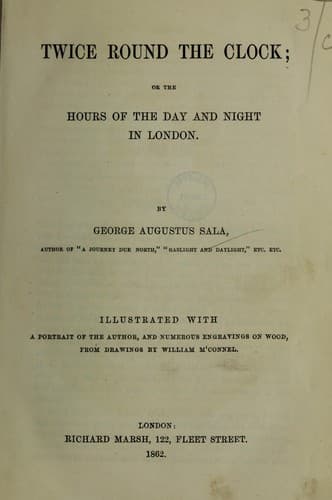
Twice round the clock; or, The hours of the day and night in LondonSala, George Augustus
General
Twice round the clock; or, The hours of the day and night in London
Sala, George Augustus
London (England) -- Social life and customs -- 19th century
Of course there are some titled folks at Mrs. Van Umbug’s conversazione:
it would not be complete without a literary lord—a harmless nobleman,
generally, who has translated Horace, invented a new metre, or discovered
a new butterfly; and a literary lady—if separated from her husband all
the better, who paints him in the darkest of colours, as the hero of
every one of her novels. And, equally of course, Ethelred Guffoon is
here. Ethelred Guffoon is everywhere. He is one of Mrs. Van Umbug’s
special favourites. She calls him by his Christian name. He hunts up new
lions for her; occasionally he officiates as peacemaker, and prevents
the lions from growling and fighting among themselves. He rushes from
Mrs. Van Umbug’s conversazione to the Pontoppidan Theatre, to see a new
face, which he must criticise; after that he will sit up half the night
to review Mr. Gladstone’s Homer, for the “Daily Scratcher,” and will be
at Somerset House by punctual office hours the next morning. A man of the
age, Ethelred Guffoon—a man of the time, a good fellow, but frivolous.
I wonder whether the celebrities one sees at this shadowy conversazione
really represent the literary world—the real people who write the books
and think the thoughts. I am afraid they do not. I fear that to find
the princes of the pen, the giants of the land of letters, I must go
further afield. Lo, here is Great Tom of Chelsea, sitting cosily, in
his back parlour, smoking a pipe of bird’s-eye with Eglintoun Beaverup,
and telling him he is about having his ceilings whitewashed. Here is
Lord Livy poring over Restoration and Revolution broadsides by his
reading-lamp in his lonely chambers in the Albany;—no, not lonely, the
spirits of the old historic men come from their dusty shelves and clap
him on the shoulder, and cry, “Go on and prosper, Thomas Babington,
Lord Livy.” The great Mr. Polyphemus, the novelist, is bidden to the
Duke of Sennacherib’s, and as he rolls to Sennacherib House in his
brougham, meditates satiric onslaughts on “Tom Garbage” and “Young
Grubstreet”—those Tom Thumb foes of his[12]—in the next number of the
“Pennsylvanians.” Mr. Goodman Twoshoes is reading one of his own books
to the members of the Chawbacon Athenæum, and making, I am delighted
to hear, a mint of money by the simple process. Goldpen, the poet, has
taken his wife and children to Miss P. Horton’s entertainment; Bays, the
great dramatist, is sitting in the stalls of the Pontoppidan Theatre
listening with rapt ears to the jokes in his own farce; and Selwyn Cope,
the essayist, is snoring snugly between the sheets, having to rise very
early to-morrow morning in order to see a man hanged. And where are the
working-men of literature, the conscripts of the pen, doomed to carry
Brown Bess, for sixpence a day, all their lives? Where are Garbage and
Grubstreet? In the worst inn’s worst room, with racing prints half hung,
the walls of plaster and the floors of sand, at once a deal table but
Public-domain text, read in full here on John Shaqi.
Reviews
Reviews
No reviews yet
Be the first to share your thoughts on this work.
Elsewhere in the archive
Join the Discussion
Join the discussion
Sign in to leave a comment or review.
Sign InorCreate an account