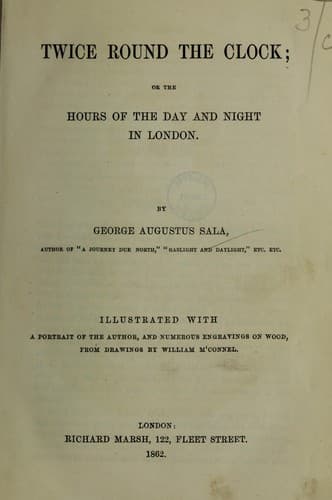
Twice round the clock; or, The hours of the day and night in LondonSala, George Augustus
General
Twice round the clock; or, The hours of the day and night in London
Sala, George Augustus
London (England) -- Social life and customs -- 19th century
I spoke of link-men. I might tell you a not uninteresting story regarding
those industrials, in these gas-lit days growing day by day rarer and
rarer. The tarred-rope made links are indeed, save on extraneous foggy
nights, grown quite extinct, and are replaced by neat lanterns; and
the time will come when the old red jackets, famous as a class from
Grosvenor Square to the Horticultural Gardens at Chiswick, from the
club-house fronts, on _levée_ days, to the doorways of evening parties,
shall become quite obsolete. But there is a grand old admiral living
now—titled, high in office, before whom even his equals in rank bow, and
who can make post-captains wait in his ante-chambers—who owes at least
half his advancement and social position to the services of the link-men.
Thirty years ago this officer was a young stripling, cast upon the ocean
of London society. He was of good family, but his acquaintances in the
fashionable world were few and far between, his influence was _nil_, and
his promotion was therefore more than dubious. But at the Opera, then the
King’s Theatre, he happened to form a shilling-giving on the one side,
cap-touching on the other, acquaintance with a link-man—Silver Tom, I
think he was called, from a silver badge he always wore, presented to him
by a noble marquis whom he had saved from being prematurely scrunched on
a certain dark night between his own carriage wheels and those of the
equipage of a duchess, his grandmamma. “Silver Tom,” moved by gratitude,
and experienced by his (outside) knowledge of the fashionable world,
put the then young and poor lieutenant up to what is vernacularly
known as “a thing or two.” Not a grand entertainment could be given in
Fashionabledom, but on the lieutenant’s arrival in full evening costume,
“Silver Tom” bawled up his name to the footman in attendance on the
door-step (the _régime_ of cards was not so strictly attended to as it is
now); he on the door-step halloaed it out to the powdered attendant on
the first landing; he, in his turn, gave it to the black-vestmented groom
of the chambers, who proclaimed it to the world in general in sonorous
tones, and the bold lieutenant was inducted to the saloons of reception.
Who was to know whether he had been invited to the feast or not? Not,
certainly, the hostess, who, perhaps, did not know two hundred and fifty
of her five hundred guests by sight. Some had been asked by her husband,
some by herself. Not certainly the guests, who would not have been
much surprised if they had met the Hottentot Venus or the King of the
Cannibal Islands. The lieutenant made his bow and himself comfortable;
was sure to meet some lady or gentleman in society whom he knew, and
probably departed with a list of half-a-dozen newly-formed and valuable
acquaintances. He went on and prospered. Gradually, from being met and
liked at great houses, he received genuine invitations, and, as I have
premised, he made a good end of it at the Admiralty. I hope he pensioned
Public-domain text, read in full here on John Shaqi.
Reviews
Reviews
No reviews yet
Be the first to share your thoughts on this work.
Elsewhere in the archive
Join the Discussion
Join the discussion
Sign in to leave a comment or review.
Sign InorCreate an account