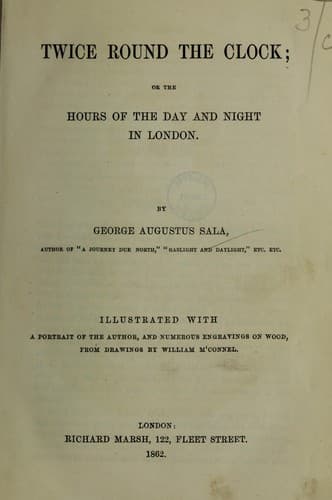
Twice round the clock; or, The hours of the day and night in LondonSala, George Augustus
General
Twice round the clock; or, The hours of the day and night in London
Sala, George Augustus
London (England) -- Social life and customs -- 19th century
Midnight: the play is over, and the audience pour from the Haymarket
Theatre. The aristocratic opera season is concluded by this time of the
year, and the lovers of the drama have it all their own way. Crowds of
jovial young clerks and spruce law students cluster beneath the portico,
yet convulsed by the humours of Mr. Buckstone. Happy families of rosy
children, radiant in lay-down collars, white skirts and pink sashes, trot
from the entrance to the dress-circle under the wing of benevolent papa
and stout good-humoured mamma, with a white burnous, and a tremendous
fan; their healthy countenances all beaming and mantling with smiles,
and joyously recalling the jokes of that funny old man in the farce, or
expatiating on the glories of the concluding _tableau_, with its tinsel
and gold leaf, its caryatides of ballet girls, and its red and blue
fire, in Mr. Talfourd’s last sparkling burlesque. Happy, happy days
and frame of mind, when the theatre can give such delights as these.
Isn’t it better to sit amazed and delighted in the front row of the
dress-circle, or on the third row of the pit, roaring at the stalest Joe
Millerisms, and clapping the hands at the tomfool feats of tumbling, than
to lie _perdu_ in a private-box, now scowling, and now sneering, like
Stricknine, the great theatrical critic, who will go and sup afterwards
at the Albion, on an underdone mutton-chop, and, calling for pen, ink,
and paper, slaughter the inoffensive burlesque mercilessly. Stricknine
can’t write burlesques himself. He can’t write books; he can only
slaughter, and must have been apprenticed in his youth to Bannister or
Slater. And, slaughterer as he is, he is not equal to the manly business
of knocking down a bullock with a pole-axe. Give him a long keen knife,
and he will puncture the neck of a lamb, and that is all.
Public-domain text, read in full here on John Shaqi.
Reviews
Reviews
No reviews yet
Be the first to share your thoughts on this work.
Elsewhere in the archive
Join the Discussion
Join the discussion
Sign in to leave a comment or review.
Sign InorCreate an account