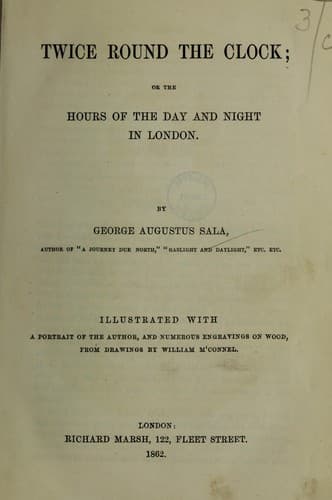
Twice round the clock; or, The hours of the day and night in LondonSala, George Augustus
General
Twice round the clock; or, The hours of the day and night in London
Sala, George Augustus
London (England) -- Social life and customs -- 19th century
And, after all, I have only introduced him as a species of
gentleman-usher to another foreign acquaintance—with whom my intercourse
was even more transient, for I met him but once in my life, and then
had only about seven minutes’ conversation with him on the deck of a
steamer—whose knowledge of English and recollection of England were even
more limited. “Ver fine place,” he remarked, referring to my native land.
“Moch night plaisir, London. Sing-song ver good. Ev’ns magnifique.”
There, the secret of my digression is out now, and I land you—somewhat
wearied with the journey, it may be—under the Piazza of Covent Garden
Market.
Mr. Charles Dickens once declared in print that were he to start a horse
for the Derby, he would call that horse Fortnum and Mason: the delightful
hampers of edibles and drinkables vended by that eminent firm about the
period of Epsom Races being connected with the most pleasurable of his
impressions concerning that exciting sporting event. I have no doubt
that my steamboat acquaintance was not by any means solitary in his
enthusiastic estimate of the “magnifique” nature of Ev’ns, or EVANS’S,
and its “sing-song;” and his opinion is, I have reason to believe,
shared by many hundreds of English country gentlemen who patronise the
Bedford, the Tavistock, the Hummums, and other kindred Covent Garden
hotels, and who at Evans’s find their heartiest welcome and their most
inexhaustible fund of amusement. Nor can I see myself, exactly, how this
great town of ours could manage to get on without the time-honoured Cave
of Harmony; for be it known to all men—at least to so many as do not know
it already—Evans’s, though Captain Costigan is no longer permitted to
sing his songs there, and even Colonel Newcome, were he to volunteer to
oblige the company with a song, would be politely requested to desist by
a waiter—is the “Cave,” and the “Cave” is Evans’s. It is not without a
certain sly chuckle of gratulation that I record this fact. Those friends
of mine who have adopted the highly honourable pursuit of hiding round
corners in order to throw, with the greater security, jagged stones at
me as I pass, those precious purists and immaculate precisians who cry
hard upon a writer on London life in the nineteenth century, because he
describes things and places which every man knows to exist, and whose
existence he for one has not the hypocrisy to deny—these good gentlemen
will scarcely be angry with their poor servant, Scriblerus, for giving a
word-picture of a place of amusement which is immortalised in the first
chapter of “The Newcomes.” And please to observe, gentlemen, that I am
not about to venture on the very delicate ground with respect to the
quality of the songs once sung at Evans’s, and so boldly trodden by Mr.
Thackeray. I have the less need to do so, as that delicate or indelicate
ground has long since—and to the honour of the present proprietor, Mr.
Green—been ploughed up and sown with salt, and the musical programme
Public-domain text, read in full here on John Shaqi.
Reviews
Reviews
No reviews yet
Be the first to share your thoughts on this work.
Elsewhere in the archive
Join the Discussion
Join the discussion
Sign in to leave a comment or review.
Sign InorCreate an account