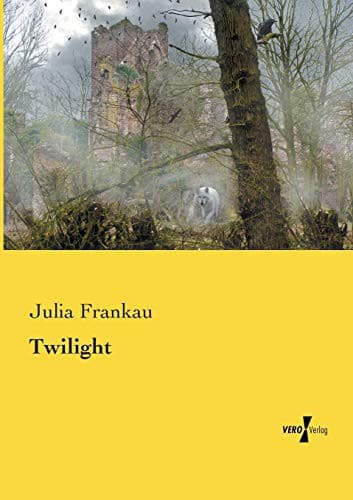
Ghosts -- Fiction; Invalids -- Fiction; Women authors -- Fiction
She was surprised at what had happened to her, thought a great deal
about it, magnifying or minimising it according to her mood. But in a
way the incident drew her more definitely toward Gabriel Stanton. She
began to admit she was in love with him, to do as he had bidden her,
“let herself go.” In imagination at least. Had she been a psychological
instead of an epigrammatic novelist, she would have understood herself
better. To me, writing her story at this headlong pace, it was
nevertheless all quite clear. I had not to linger to find out why she
did this or that, what spirit moved her. I knew all the time, for
although none of my own novels ever had the success of “The Dangerous
Age” I knew more about what the author wrote there than he did himself,
much more. The Dangerous Age comes to a woman at all periods. With
Margaret Capel it was seven years after her marriage and over six from
the time when she had left her husband. She was impulsive, and for all
her introspective egotism, most pitifully ignorant of herself and her
emotional capacity. Fortunately Gabriel Stanton was almost as ignorant
as she. But, at least after that Sunday evening, there was no more talk
of friendship between them. There was coquetting on her side and some
obtuseness on his. Rare flashes of understanding as well, and on her
part deepening feeling under a light and varying surface.
She was rarely twice alike, often she merely acted, thinking of herself
as a strange character in a drama. She was genuinely uncertain of
herself. Her love flamed wild sometimes. Then she would pull herself up
and remember that something like this she had felt once before, and it
had proved a will o’ the wisp over a bog. She wanted to walk warily.
“Supposing I am wrong again this time?” she asked him once with wide
eyes.
“You are not. This is real. Trust me, trust yourself.” She liked to
nestle in the shelter of his arm, to feel his lips on her hair, to
torment and adore him. The week-ends seemed very short; the week-days
long. Week-days during which she was restless and excitable, and Peter
Kennedy and his bag of tricks, medical tricks, often in request. She was
very capricious with Peter, calling him ignorant, and a country yokel.
As a companion he compared very badly with Gabriel. As an emotional
machine he was easier to play upon. She spared him nothing, he was her
whipping-boy. Watching him one noticed that he grew quieter, improved in
many ways as she secured more and more mastery over him. When there were
scenes now they were of her and not of his making. He was wax in her
hands, plastic to her moulding. Sometimes she was sorry for him and a
little ashamed of herself. Then she gave him a music lesson or lectured
him gravely on his shortcomings. But from first to last he was nothing
to her but a stop-gap. His devotion had the smallest of reward.
Public-domain text, read in full here on John Shaqi.
Reviews
Reviews
No reviews yet
Be the first to share your thoughts on this work.
Elsewhere in the archive
Join the Discussion
Join the discussion
Sign in to leave a comment or review.
Sign InorCreate an account