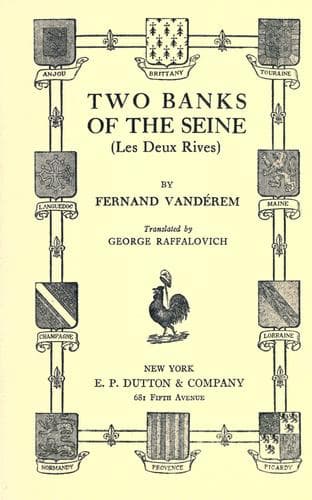
Two banks of the Seine (Les Deux Rives)Vandérem, Fernand
General
Two banks of the Seine (Les Deux Rives)
Vandérem, Fernand
Paris (France) -- Social life and customs -- 19th century -- Fiction
Zozé said nothing. Once more she saw the garden of the Louvre and the
ardent and timorous expression of M. Raindal. If only Gerald had been
there, hidden somewhere among the bushes! She was delighted with this
idea of semi-reprisals. She smoked two more cigarettes as she imagined
successively the burlesque and the pathetic sides of the scene.
* * * * *
That evening the opera exhibited one of those spring gatherings where,
in a sparkle of light, precious tones and uncovered shoulders--all the
public display of luxury and beauty, of wealth and aristocracy which had
apparently been a thing of the past, came to life again.
As soon as Zozé came in, many opera glasses from clubmen and first tier
boxes were leveled upon her.
For she had advanced in caste the little Mouzarkhi girl. They were now
putting down to her credit the two years of her liaison. If this did not
create for her a link of relationship with the surrounding fashionable
élite, at least it was a victory to her credit, a successful campaign
which made the distance appear smaller. She was no longer the little
exotic, unknown person concerning whom they had once inquired in an
almost contemptuous tone. She was almost one of themselves, the little
Chambannes woman, who had captured and kept young de Meuze for two whole
years; and under the mask of their glasses, which hid half their faces,
their lips formed smiles of good will towards her.
Then there was the presence of the old gentleman who sat next to Zozé in
the front of the box; this piqued their curiosity. They had to wait for
the interval in order to find out who he was.
In the meantime, the hope of the young Philistines appeared at the back
of the stage. Delilah led, her black hair overloaded with flowers and
multicolored jewels. They were singing in an enraptured voice a sensuous
love chorus:
"Beau-té, don du ciel, prin-temps de nos jours,
Doux char-me des yeux, es-poir des amours,
Pé-ne-tre les coeurs, ver-se dans les a-mes,
Tes dou-ces flam-mes!
Aimons, mes soeurs, ai-aimons tou-jours!"
M. Raindal stiffened himself at the sharp shiver which ran down his
back. Instinctively he looked at the audience. The silence had become
graver and more vibrant. A voluptuous tide mounted from the orchestra to
the boxes along with the languorous music. Savage lights shone in the
eyes of some of the women; breasts were panting; the heavy artillery of
the opera glasses was firing glances at full speed. Almost everyone in
the audience, men and women, after a long day of hypocrisy, acknowledged
themselves at last lovers, moved by the cynical suggestiveness of the
chorus.
Public-domain text, read in full here on John Shaqi.
Reviews
Reviews
No reviews yet
Be the first to share your thoughts on this work.
Elsewhere in the archive
Join the Discussion
Join the discussion
Sign in to leave a comment or review.
Sign InorCreate an account