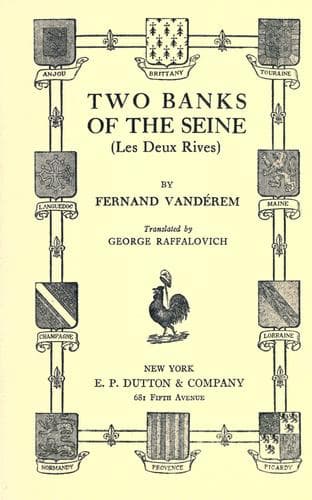
Two banks of the Seine (Les Deux Rives)Vandérem, Fernand
General
Two banks of the Seine (Les Deux Rives)
Vandérem, Fernand
Paris (France) -- Social life and customs -- 19th century -- Fiction
They eschewed the fashionable places beyond Poissy, in the neighborhood
of Saint Germain. They preferred to follow the course of the Seine,
driving towards Poutoise or even Mantes, an uneven, hilly and often
imposing region which attracted the master, as it had Mme. Chambannes.
There the wind rolled its ample currents over plateaux and hills,
carrying a strong taste reminiscent of the sea. Sometimes, at the top of
a shut-in road that climbed under the shady trees, an unexpected
perspective disclosed enormous expanses, forests, cross-roads, the
breadth of the river, a big village, oxen in a field, vine on a
hill-side, in short, the whole unexpected complexity of the provincial
countryside, far from Paris and its suburbs.
The master and Mme. Chambannes would leave about nine and not return
until time for lunch. Some days, in order to prevent idle gossip, they
took the abbé Touronde with them. M. Raindal and the priest occupied one
seat and Zozé, who was driving, the other.
One Thursday, the three of them went as far as Mantes, where the master
wished to purchase a pair of brown shoes; their arrival caused a
sensation. The strange carriage, the piquant attractiveness of Mme.
Chambannes, M. Raindal's white hair and the black robe of the abbé
impressed the curious with their cumulative effect. In front of the
bootmaker's shop, urchins surrounded the carriage. Neighboring
shopkeepers came out on their steps and passed jocular comments. This
affair and the popular emotion it caused were summed up in a short
anonymous paragraph in the _Petit Impartial de Seine-et-Oise_. Although
names were not given no one could mistake the meaning of the allusions,
from the heading, _Suzanne_, to the bitterness of the writer towards
"certain ecclesiastics, friends of the orphans" who were paying for the
abbé Touronde's holidays.
As a result of this unlucky experience Mme. Chambannes henceforth
avoided the towns.
These drives, moreover, were less of a pleasure than a mere pastime
between the hours when she read Gerald's letters--when any came--and
those when she wrote to him.
Every day, after lunch, she shut herself up, to write him long pages,
cleverly composed so as to stimulate his inert tenderness and his
somnolent jealousy. In the meantime, M. Raindal, who had gone up,
seemingly to work, enjoyed a nap on the floor above or imitated his
hostess by writing a few words to his family. It would have made a
piquant comparison to put their two letters side by side. Zozé purposely
blackened her own character, multiplied the questionable details, the
recital of episodes where her coquetry won her admiration, the masculine
homage, the fervent glances of M. Raindal, of the abbé, of a passer-by,
of all the men. The master, on the contrary, exhausted all examples in
order to whitewash her of everything suspicious, to establish her
child-like candor, her virtue and undoubted purity.
Public-domain text, read in full here on John Shaqi.
Reviews
Reviews
No reviews yet
Be the first to share your thoughts on this work.
Elsewhere in the archive
Join the Discussion
Join the discussion
Sign in to leave a comment or review.
Sign InorCreate an account