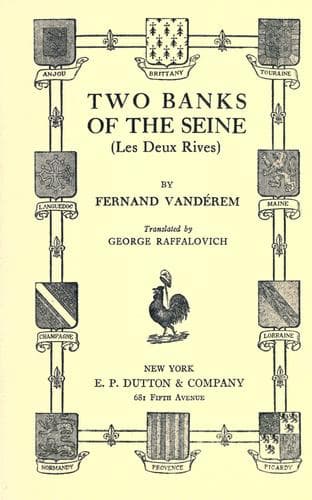
Two banks of the Seine (Les Deux Rives)Vandérem, Fernand
General
Two banks of the Seine (Les Deux Rives)
Vandérem, Fernand
Paris (France) -- Social life and customs -- 19th century -- Fiction
On such days, out of pity for his sorrows which were so similar to her
own, she was less rigorous towards the furtive kisses with which M.
Raindal sought out her hands, gloved or bare, on every possible
occasion. She racked her brains to order delicate dishes which she knew
would please him. Then, the dinner ended, if he did not fall asleep, she
read to him in the drawing-room--a newspaper or a volume of history. She
read timidly, doing her best, with incorrect intonations, little girl's
errors which almost melted the master's heart. Or else--height of
delights--she accepted his arm for a walk in the garden, along the lawn,
in front of the terrace. When the sky was cloudy, M. Raindal, under the
veil of obscurity, daringly kissed the young woman's hand. Once he
almost risked a nearer kiss, on her neck, taking advantage of the
half-décolleté evening dress which Mme. Chambannes wore. But, on the
verge of executing the movement, he was seized with such a fear that he
stopped dead on the spot.
"Are you ill, dear master?" Zozé asked.
"No!" he replied, starting again. "I was listening to the wind in the
branches!"
When he reached his room after these nocturnal frolics, he had
difficulty in going to sleep. Reflections bubbled in him in foaming
cascades. He counted up the number of kisses Mme. Chambannes had
tolerated since the morning: one in the Verneuil wood, another in the
park before lunch, another in the afternoon, in Zozé's own room, where
he had gone on the pretext of asking for a book, a fifth and even a
sixth one in the evening, below the terrace.... He modestly admitted to
himself that these were childish calculations and not devoid of vanity!
But what weight have metaphysical considerations against the
overwhelming reality of our joys? The latter know no other limit than
the variations of our feelings. If they reach exaltation, we should not
dismiss their enthusiasm with contempt; if they fall or diminish, what
philosophy can lift them up again? Thus M. Raindal meditated, with a
growing scorn for speculative pleasures.
He often reached a state of extreme frankness, in the course of those
solemn examinations, when his naked soul spoke to his mind, as a wife to
her husband. It was quite true! M. Raindal did not attempt to deny it;
he was slightly in love with his pretty little pupil. At her approach,
he felt himself blush; he felt those emotions and internal flutterings
which, according to general opinion, are signs of infatuation. To be
sure, it was a harmless love, a flame that could not scorch, the last
radiation of his heart! What danger did he run in rejoicing at those
crepuscular lights which life, in a last act of kindness, sometimes
kindles again on the road that leads to the grave? What wrong did he do
when he drew from those illicit kisses a sensation of renewed youth, a
continuous denial given to the fatal decline of his years?
Public-domain text, read in full here on John Shaqi.
Reviews
Reviews
No reviews yet
Be the first to share your thoughts on this work.
Elsewhere in the archive
Join the Discussion
Join the discussion
Sign in to leave a comment or review.
Sign InorCreate an account