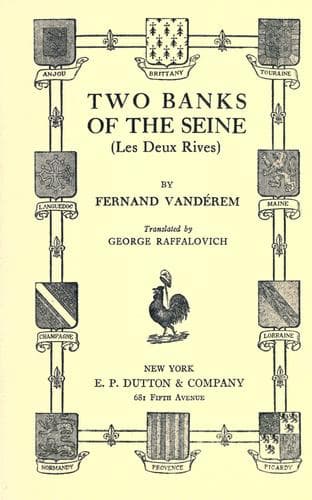
Two banks of the Seine (Les Deux Rives)Vandérem, Fernand
General
Two banks of the Seine (Les Deux Rives)
Vandérem, Fernand
Paris (France) -- Social life and customs -- 19th century -- Fiction
His eyes burned, for he had wept again in the train, careless of all
pride, unable to resist his pain. Zozé had fallen in with his wishes by
not accompanying him to the station. The parting had been public, before
Aunt Panhias, the Marquis de Meuze, Gerald and Chambannes all gathered
together. The master had purposely come down late in order to shorten
the cruel instant. Vain calculation! He had had to wait fully five
minutes on the steps, before them all, to smile, speak and answer
questions.... What a martyrdom it had been! If only he had been able to
kiss Zozé's hand, to kiss it with fire, with intoxication, as before
... to take a last taste of that forsaken delight!... But they were
looking! It had been, instead, a cold and superficial kiss on the
fingers of his little pupil, and it had seemed to him that his very lips
were surprised! Well, these torments had been slight, compared to those
that would soon follow!
To-morrow he would be at Langrune, miles and miles away, compelled to
explain his return, a prisoner of his family, exiled on a gloomy
seashore! To-morrow, he would be once more Mme. Raindal's husband, Mlle.
Raindal's father, _M. Raindal, of the Institute_, an austere old savant,
with no one to make his life pleasant, with no clandestine friendship,
no little pupil, no secret distraction, apart from his books--books to
write, books to read, books to review!...
"Books, books, always books!" he murmured, in a sickened tone.
And a thought intrigued him; it was to stay in Paris and find some means
of avoiding Langrune.
The clock of the station struck seven. He paid the waiter and walked
towards the boulevards.
Where could he dine? He remembered the name of a restaurant, in the
place de la Madeleine, the cooking of which Chambannes and the Marquis
had often praised before him.
He sauntered in that direction. The room was still half empty. He
ordered a choice dinner, with such dishes as Zozé preferred, a bottle of
_Saint-Estephe_ and a bottle of frappé Champagne which was placed before
him in a silver vase. His absinthe encouraged him to these libations.
Since he had drunk it, he felt livelier and less sad.
He ate abundantly and applied himself to drinking. His ideas became
lighter and seemed to penetrate one another. It was a pleasant
confusion, and made him giggle at times. Towards the end of the dinner,
he conceived the project of a drama, a myth in dialogue form, which
would be entitled _Hercules_. He would show Vice, under the guise of a
woman--who in the master's mind resembled Zozé exactly--entering the
house of the now aged hero. And the latter would lament, would weep over
his departed youth, and would implore the gods to give it back to
him.... The drama developed according to this theme, in lofty axioms and
lyrical plaints.
Public-domain text, read in full here on John Shaqi.
Reviews
Reviews
No reviews yet
Be the first to share your thoughts on this work.
Elsewhere in the archive
Join the Discussion
Join the discussion
Sign in to leave a comment or review.
Sign InorCreate an account