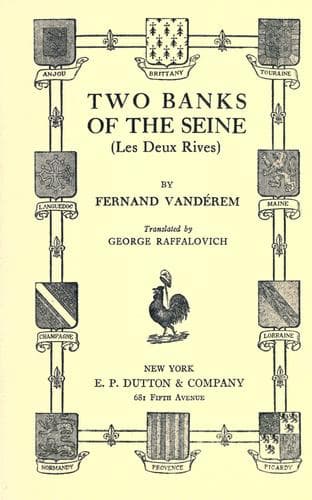
Two banks of the Seine (Les Deux Rives)Vandérem, Fernand
General
Two banks of the Seine (Les Deux Rives)
Vandérem, Fernand
Paris (France) -- Social life and customs -- 19th century -- Fiction
He paused, ever careful of measure, of truth and exactness, then added:
"I shall not go so far as to tell you that I am indifferent to these
money considerations.... On the contrary, it is certain that a dowry and
some expectations would have been a precious help to my wife's comfort
and the education of our children.... But our marriage can easily take
place without this help. I feel that I am full of energy, and the
prospect of a little more mediocre work is not enough to move the young
and vigorous man I feel myself to be.... Therefore, I maintain my
request, dear master!"
Schleifmann left the room to join the medical student. M. Raindal and
the young savant shook hands affectionately; then, each on a chair,
their chins in their hands, they fell gradually asleep.
Towards dawn, the interne woke them all up. The agony had begun. It
proved a long one. Uncle Cyprien's insurgent soul rebelled against death
as it had rebelled against life. Choked by blood, he wished to breathe,
to live still; his well arm repulsed the asphyxia with an imperative
gesture which seemed to express his indignation.
Finally he lost his breath. He distended his purple face, his twisted
lips in a supreme effort and fell back, defeated, immobile, delivered.
Mme. Raindal threw herself on her knees and prayed with abundant tears.
Schleifmann, one elbow resting on the marble mantel-piece, his hands
over his eyes, quietly chanted some Hebraic words. Thérèse sobbed on her
father's shoulders.
The interne opened the window and pushed back the shutters through which
there already came some golden rays.
With the fresh splendor of the morning brightness an outburst of
chirping penetrated the room.
It was the sparrows of the Luxembourg which sang merrily on the
branches, unwittingly chirping a last good-by to their old friend,
Cyprien Raindal.
CHAPTER XIX
On the morning of the burial, Thérèse was in her room, busy sorting
papers they had found in her uncle's room, when Brigitte knocked at the
door.
"A lady, mademoiselle!" the maid said. "Mme. Chambannes, I think."
A frown appeared on Mlle. Raindal's velvety eyebrows.
"Did you tell her that monsieur and madame had gone out?"
"Yes, mademoiselle! But she said that she would like to see
mademoiselle. She is in the drawing-room."
"Very well, I'll go!" Thérèse replied.
She threw a rapid glance in the mirror, to examine her dress and her
hair, as a woman does on marching to a decisive encounter. Her stiff
crêpe collar like the neckpiece of a suit of armor kept her head more
erect and made her physiognomy more aggressive and severe. The corners
of her thin lips arched in an aggressive smile. Ah! Mme. Chambannes
wishes to see her! Well, all right! She would see her and hear her too!
She was going to have her wishes, that lady, and perhaps more than that.
Public-domain text, read in full here on John Shaqi.
Reviews
Reviews
No reviews yet
Be the first to share your thoughts on this work.
Elsewhere in the archive
Join the Discussion
Join the discussion
Sign in to leave a comment or review.
Sign InorCreate an account