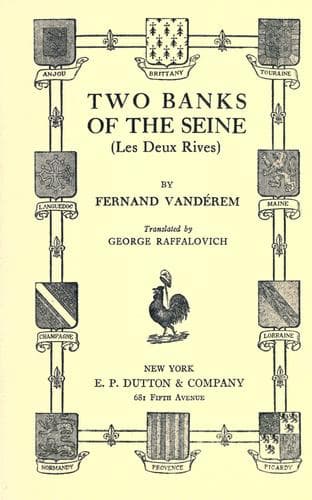
Two banks of the Seine (Les Deux Rives)Vandérem, Fernand
General
Two banks of the Seine (Les Deux Rives)
Vandérem, Fernand
Paris (France) -- Social life and customs -- 19th century -- Fiction
Let them attack him; let them but ask a question and he would know how
to exonerate himself! What harm was he doing, anyhow? Was he running
from salon to salon, as did so many of his colleagues? Had he taken
advantage of his triumph to break into the little literary Bastilles
which were the final goal of so many paltry ambitions? Had he not, on
the contrary, declined, one after another, all the invitations given
him, by Mme. Pums, by Mme. Herschstein, by Mme. de Marquesse, even by
ladies of higher social status whom he could name if called upon? Had he
not a score of times discreetly urged his wife and daughter to pay the
call they owed the Chambannes? Was he not ready to take them to the rue
de Prony as often as they could wish? Did he manifest any spite, as so
many others might do, for all the deceptions and for the bitterness
which Mme. Raindal's uneasy religiosity had scattered between them? Did
he play the part of a bad husband, a bad father, a frivolous and
dissipated man?... Well then, what was it they reproached him with? Why
was he compelled to suspect his own family as he had to suspect his own
sworn enemies? There was that wretch of a Saulvard, for instance, who
carried the rancor of his defeat to the point of declining three
successive invitations of Mme. Chambannes.... The entanglement of his
worries, added to the silence he imposed upon himself, made him feel
disgusted with his own house, his home and everything that he had until
then considered as happiness and quiet.
He proved his own innocence to himself so often that doubts came to him
at times. He asked himself whether his friendship with young Mme.
Chambannes was not such as might cause him some prejudice in the
scientific world, whether it might not be more seemly for him to allow
more time to pass between his visits, and whether his regularity might
not be affording the evil-minded an opening. At once a rebellion which
he attributed to pride moved him to smile at such scruples. He derived
from his reflections a new energy for the indulgence of his inclination.
Throughout the week, he lost no opportunity, whether at the dining-table
or elsewhere, to flay the ridicule of pedantry, the hypocrisy of austere
people, a whole mass of foibles and of anonymous characters, upon whom,
with no less good grounds, Mme. Raindal, Thérèse and Uncle Cyprien might
have bestowed their own names as well. Thus came the Thursday, and he
made his exit with a provocative, almost bellicose, banging of all the
doors in succession.
Public-domain text, read in full here on John Shaqi.
Reviews
Reviews
No reviews yet
Be the first to share your thoughts on this work.
Elsewhere in the archive
Join the Discussion
Join the discussion
Sign in to leave a comment or review.
Sign InorCreate an account