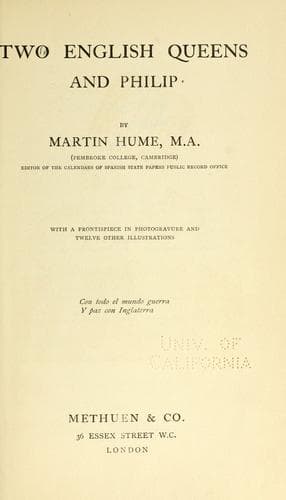
Two English queens and PhilipHume, Martin A. S. (Martin Andrew Sharp)
Philosophy
Two English queens and Philip
Hume, Martin A. S. (Martin Andrew Sharp)
Already Elizabeth’s sun was seen to be in the ascendant, and, regardless
of the feelings of her sister the Queen, it suited Spanish policy to
ensure her marriage, if possible, with a nominee dependent upon Philip.
How anxious Philip personally was not to lose touch of Elizabeth at this
juncture is seen in his reply at the end of May to a suggestion of Feria
that the latter should go to Hatfield and pay his respects to her before
he left England: “What you say about visiting Madam Elizabeth before you
depart appears to me to be very wise, for the reasons you point out,
and I am writing to the Queen, saying that I have ordered you to go.
You will act accordingly; and I have no doubt that when the Queen sees
the firmness with which I write on the subject she will consent.”[129]
Philip’s fiery and impetuous ambassador Feria went considerably beyond
his master in his high-handed dealing with the English Government; for
Philip’s methods were diplomatic and far-seeing, and his object was not
to ride roughshod over his wife’s country, as Feria would have done,
but to use its resources for his ends, as if without design, and to
perpetrate his hold upon it after his wife’s death.
Mary, still suffering from her usual indispositions, persuaded herself
in May that Philip was coming over to see her again. It was, as Feria
said, unreasonable; for Philip was overweighted with business, arranging
the summer campaigns and a thousand other things: but Mary, full of hope
again, caused herself to be carried to St. James’s to be ready to receive
her husband, and had horses and lodgings prepared for him from Dover to
Gravesend and an escort of ships at Dover to convey him across. Feria
told her blankly that the King was too busy to come, and again pressed
her about raising the land army to reinforce Philip in Flanders. He found
her less ready in the matter than he had hoped—“for the Cardinal and
Council persuade her as they like”—and she wearily suggested that Clinton
should go to Brussels to discuss the matter with the King. “This,” said
Feria, “was only because they think that I push them too hard; and they
believe they can deal more easily with your Majesty, their real object
being to upset the scheme altogether;” and the ambassador continues by
recommending the King when Clinton arrived in Brussels to deal with him
high-handedly, blaming the Council angrily for their slackness in the
past. Clinton was evidently the most pliant tool of all; and yet, even of
him, Feria writes: “Nothing that he says will be true, unless he thinks
it will be investigated. I have had no end of trouble about this, for
they do nothing but lie and prevaricate.”
Public-domain text, read in full here on John Shaqi.
Reviews
Reviews
No reviews yet
Be the first to share your thoughts on this work.
Elsewhere in the archive
Join the Discussion
Join the discussion
Sign in to leave a comment or review.
Sign InorCreate an account