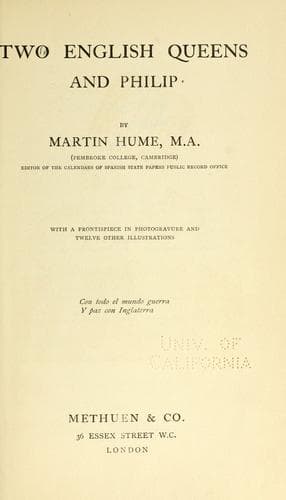
Two English queens and PhilipHume, Martin A. S. (Martin Andrew Sharp)
Philosophy
Two English queens and Philip
Hume, Martin A. S. (Martin Andrew Sharp)
At the same time the Bishop urged upon his master that the moment had now
come for action: either this bargain must be struck with Dudley, or help
must be given to the enemies of the existing _régime_ to revolutionise
England. “To let these affairs drift at the mercy of chance neither
secures England to us nor punishes evil, and must end in disadvantage
to your Majesty.” Philip was just as sanctimonious in profession and as
pliable in practice as his ambassador. “Our principal aim,” he wrote
in reply, “is directed to the service of our Lord, the maintenance of
religion, and the settlement and pacification of England, and, as we see
that Sidney’s proposals tend to this, and further bearing in mind that
God if He wills can extract good from evil, we have decided that the
negotiation suggested by Sidney should be listened to.” Dudley was to
be helped to marry the Queen, but “the bargain and its payment must be
clearly set forth in writing signed by Elizabeth herself, and she must
give some earnest of her sincerity by liberating the Catholics she has
in prison, she must undertake to send Catholic bishops and ambassadors
to the Council of the Church, and submit herself unconditionally to
its decisions. And, besides all this, she must begin by giving full
toleration to Catholic worship.”
This, again, shows that Philip was utterly at sea as regards the real
condition of England at the time, and was still ignorant of Elizabeth’s
character and position. Such demands as those he formulated as a
preliminary were utterly out of the question, even as a final concession.
Before this letter was received in London the insincerity of Elizabeth
in the matter began to appear. The Earl of Bedford was sent to France,
ostensibly to condole with Catharine for the death of Francis II.; but
also to suggest that the French bishops—and especially those of Huguenot
leaning—should join her in sending representatives to the Council, but
not at Trent, as had been agreed, but somewhere else on this side
of the Alps. The cleverness of this move is apparent. Catharine and
Elizabeth would in such case seem to be making common cause, which
would paralyse Philip; and at the same time the Catholics in England
would be tranquillised with the idea that a Council of the Church would
settle matters to their liking. Catharine, however, did not jump at the
bait, as just then in the first days of her Regency she did not wish to
quarrel with her Spanish son-in-law, or to drive the Catholic Guises to
desperation by seeming to join with Elizabeth against them.
Public-domain text, read in full here on John Shaqi.
Reviews
Reviews
No reviews yet
Be the first to share your thoughts on this work.
Elsewhere in the archive
Join the Discussion
Join the discussion
Sign in to leave a comment or review.
Sign InorCreate an account