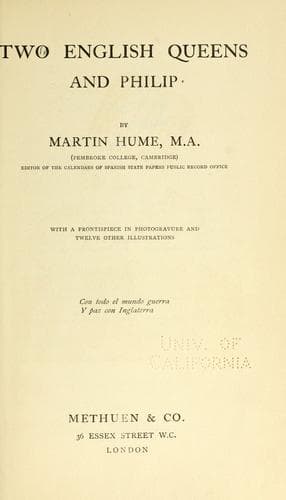
Two English queens and PhilipHume, Martin A. S. (Martin Andrew Sharp)
Philosophy
Two English queens and Philip
Hume, Martin A. S. (Martin Andrew Sharp)
The Flemish merchants, on the other hand, were almost bankrupt by the
loss of the English trade, and were clamorous to Philip to remedy the
matter.[151] Elizabeth could afford to stand firm and resist all attempts
to force her into an inferior position in the negotiations. She had taken
Philip’s measure by this time, and knew that whilst his own Netherlands
were seething in revolt, and the Catholic party in France were held in
check by the Huguenots, he dared not seriously injure her. So at last it
was not the Queen of England, but Philip, who had to speak humbly; and in
June, 1564, there arrived in London a Spanish ambassador of rank, a canon
of Toledo, Diego Guzman de Silva, on a new errand. His instructions were
precise, and his position was quite distinct from that formerly held by
haughty Feria and of Bishop Quadra. They had both had for their mission
the forcing of a policy upon a new unstable Queen, whilst Guzman was
sent to seek a redress of grievances, and by diplomacy and moderation to
compass what threats and retaliation had failed to accomplish. Philip’s
hands, indeed, were then too full of his own troubles, both in the
Mediterranean and Flanders, for him to hope to rule other countries,
and bitter as it must have been for him, and still more bitter for the
statesmen of the Alba school, he was forced to speak mildly through his
new ambassador to the heretic Queen to prevent the ruin of his Catholic
Flemish subjects. To this pass had he been brought in six years from the
time when in the days of Mary he had worked his will in England almost
unchecked.
Public-domain text, read in full here on John Shaqi.
Reviews
Reviews
No reviews yet
Be the first to share your thoughts on this work.
Elsewhere in the archive
Join the Discussion
Join the discussion
Sign in to leave a comment or review.
Sign InorCreate an account