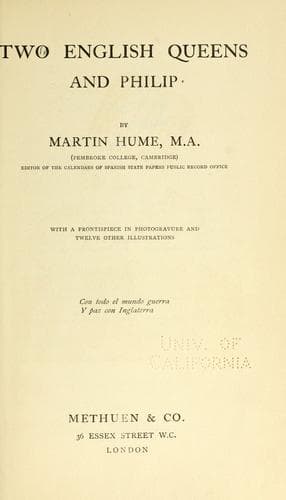
Two English queens and PhilipHume, Martin A. S. (Martin Andrew Sharp)
Philosophy
Two English queens and Philip
Hume, Martin A. S. (Martin Andrew Sharp)
On Ash Wednesday, 1565, Elizabeth listened to an open-air sermon preached
by Dr. Nowell, Dean of Saint Paul’s, an ardent Reformer, who probably was
not a politician. In the course of his sermon he condemned the veneration
of images, and Elizabeth angrily told him not to talk upon that subject.
Nowell either did not hear her or did not choose to regard the rebuke,
and continued, when the Queen again raised her voice and peremptorily
commanded him to pass to another subject, as that one was worn out. Soon
afterwards de Foix, in conversation with Guzman, remarked that the Queen
might have avoided so public and marked an interruption of the preacher.
The Spaniard was of another opinion. “I think quite differently,” he
said. “Those who sin publicly must be publicly rebuked; and as this Queen
does, so might your most Christian King do it: when he gets older he
will, I fear, be likely to make more account of the heretics.”
The much feared interview of Bayonne, which the warlike party in Spain
hoped would result in the crushing of Protestantism and the eventual
submission of England to Spanish dictation, took place in these not very
encouraging circumstances in May, 1565. Elizabeth, as a diversion, had
been for months negotiating with Catharine for a French marriage, and
the Queen Regent of France was taken aback when she saw at Bayonne the
articles which she was expected to sign. The total extermination of
Protestantism in France and the world over would have meant her personal
political extinction, and probably that of her son’s realm; for Philip
in that case would have been paramount. What she wanted was not this,
but to be able to play the Guises off against the Bourbons, and keep
Elizabeth always as a potential ally when the Catholics grew too strong
to suit her. At Bayonne, therefore, whilst she ostensibly acceded to
everything dictated by Alba and Lorraine, and led her devoutly Catholic
and hispanolised daughter to believe that France with all its national
power would support her husband’s objects, Catharine no sooner turned her
face towards Paris than she began to introduce all sorts of conditions
and limitations which stultified the whole plan of the Catholic League,
whilst she became more warmly interested than ever in the talk of
Elizabeth’s marriage with one of her sons.
Public-domain text, read in full here on John Shaqi.
Reviews
Reviews
No reviews yet
Be the first to share your thoughts on this work.
Elsewhere in the archive
Join the Discussion
Join the discussion
Sign in to leave a comment or review.
Sign InorCreate an account