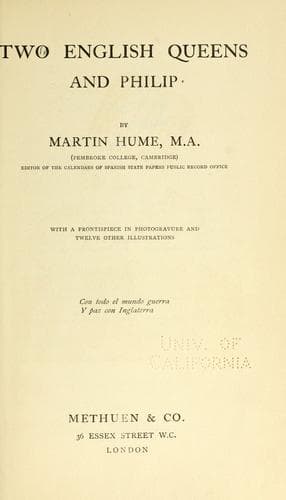
Two English queens and PhilipHume, Martin A. S. (Martin Andrew Sharp)
Philosophy
Two English queens and Philip
Hume, Martin A. S. (Martin Andrew Sharp)
The tragedy of Rizzio, the vicious foolishness of Darnley, the levity
of Mary, and the falsity of Murray and Morton, destroyed for a time the
great dream, once so promising in appearance, that the Queen of Scots
would mount the Catholic throne of Britain by the aid of Spain. When Mary
was in Lochleven and her infant son had been adopted as their King by
the nobles, Elizabeth and Catharine vied with each other in their loud
expressions of sympathy with a Queen thus contemned by her subjects,
the object in both cases being to obtain, if possible, either through
Mary or her persecutors, a pretext to interfere in Scotland, and thus
to frustrate the Spanish combination. Murray, who was not in Scotland
when Darnley was murdered, found himself assiduously courted, by the
French especially, on his way home, and had a long friendly interview
even with Guzman in London. After the first shock of dismay caused to
the Catholics by the marriage of Mary to Bothwell—a divorced man and a
Protestant—public opinion on their part agreed to regard her as innocent
of the crimes laid to her charge; and when, on the unhappy 16th May,
1568, Mary, weeping with grief and bitter disappointment, bade a last
farewell to the land of her fathers to claim the hospitality of her
bitterest enemy, her party in the north still founded their hopes upon
her, notwithstanding the black suspicion that hung over her, whilst she
was unsubdued and full of plans for future triumph over her enemies.
In her first letter to Elizabeth she struck a high but unwise note,
claiming admission to the Queen’s presence and English aid to subdue her
rebel subjects, failing which she demanded leave to go to France or Spain
and obtain assistance there. Elizabeth refused both requests, for whilst
she was kept in England the unhappy Mary had nothing to offer in return;
but Knollys, who took the message, warned the Queen of England that the
Catholic gentry were flocking to salute the fugitive, whose presence in
the north was a danger, and Mary sent indignant and imprudent messages
by Lord Herries to Elizabeth threatening to appeal to her great Catholic
friends on the Continent. This attitude sealed Mary’s fate and determined
her imprisonment. Lord Herries talked openly, even in Elizabeth’s palace,
of his plans for claiming Catholic aid for his mistress; and although
Guzman used all his deft persuasions to soften the English Queen,
Elizabeth explained to him quite cogently again and again that she dared
not allow Mary to bring foreign Catholic forces into Britain, nor from a
safe refuge on the Continent to organise disaffection in England.
Public-domain text, read in full here on John Shaqi.
Reviews
Reviews
No reviews yet
Be the first to share your thoughts on this work.
Elsewhere in the archive
Join the Discussion
Join the discussion
Sign in to leave a comment or review.
Sign InorCreate an account