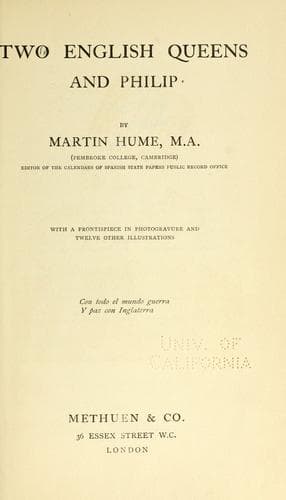
Two English queens and PhilipHume, Martin A. S. (Martin Andrew Sharp)
Philosophy
Two English queens and Philip
Hume, Martin A. S. (Martin Andrew Sharp)
The first suppression of revolt in Flanders effected by Alba on his
arrival coincided with a change in Philip’s policy towards England,
probably under the influence of the warlike party now dominant in his
counsels. Guzman, as we have seen, had always spoken fair to Elizabeth
and Cecil, though he often complained to his master of having to deal
with “heretics” thus. But from Madrid now a harsher note was struck. The
English spies in Spain reported that all the talk now was of the coming
conquest of England, and of Catholic combinations to overthrow the Queen;
and in February Elizabeth learnt from a messenger sent by her ambassador
in Spain, Dr. Man, Dean of Gloucester, to inform her of the imprisonment
of Don Carlos, that the household of her ambassador had not been allowed
to celebrate Protestant worship in the embassy building. Dr. Man was a
notoriously foolish, babbling person, and, as Philip averred, had openly
scoffed at a religious procession, and had spoken at dinner before
Spaniards disrespectfully of the Catholic faith. The Duke of Feria had
been sent to warn him, which we may be sure he did haughtily enough,[171]
and Philip, on Man’s first arrival in Madrid, appears to have told him
harshly “that he must conduct himself as his predecessors had done.” The
Inquisition had, so Philip declared, complained of him, and he was said
to have acted “simply as a perverse dogmatiser.”
However this may have been, the prohibition of his own national worship
within the embassy walls was a violation of diplomatic privilege, though
Philip said that other English ambassadors (meaning Challoner) had put up
with it; and when Elizabeth heard of it she was violently angry. Cecil
went to Guzman and told him heatedly that unless the English ambassador
in Madrid had the same privileges conceded to him as those that Guzman
enjoyed in London, he would immediately be withdrawn. Philip, said
Elizabeth, might do as he liked with his own subjects, but he should not
persecute hers. The complaint, of course, went to Madrid, and at the
same time a letter to Dr. Man from the irate Elizabeth ordering him to
demand immediate satisfaction from the King. Philip was ready for it and
gave him no opportunity. In a violent letter to Guzman, entirely unlike
his previous tone towards England, he tells his ambassador that he has
banished Man from Madrid, and refused to have any more intercourse with
him. He had, says the King, even tried to proselytise in Spain; and if
he had not been an ambassador the Inquisition would have made short work
of him. If Elizabeth did not recall him at once, he would be expelled
from Spain. When Guzman waited upon Elizabeth early in May, 1568, with
this message and handed her his new letter of credence, he watched her
face closely. “When she came to the latter part about the ambassador she
changed colour and seemed annoyed, asking me what it meant.” Guzman, as
gently as he could, gave her the rough message, and said that a gentleman
Public-domain text, read in full here on John Shaqi.
Reviews
Reviews
No reviews yet
Be the first to share your thoughts on this work.
Elsewhere in the archive
Join the Discussion
Join the discussion
Sign in to leave a comment or review.
Sign InorCreate an account