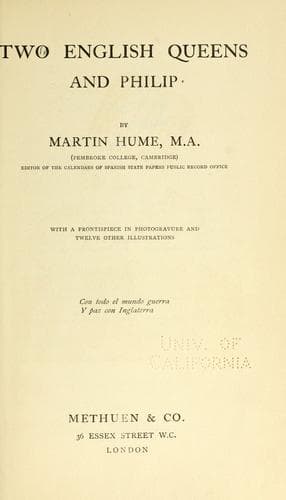
Two English queens and PhilipHume, Martin A. S. (Martin Andrew Sharp)
Philosophy
Two English queens and Philip
Hume, Martin A. S. (Martin Andrew Sharp)
All this foregathering with Scottish agents on the part of de Spes was
not lost upon the English Government, whose spies reported everything. De
Spes says that Cecil sneeringly asked Beton (the nephew of the Archbishop
of Glasgow, who was in London on his way from Paris to see Mary) “whether
he had been with his complaints to the new Spanish ambassador yet, and
how often he went to Paget House.” In these circumstances it is not
surprising that relations grew rapidly acrimonious between Philip’s
ambassador and Elizabeth’s ministers. He pressed with boldness and
persistence the claims of the Spanish shipmasters for the depredations
committed by English rovers, and by the Huguenots and Dutch rebels
who took shelter in English ports; and to these claims Cecil retorted
by bringing up the old grievance of Dr. Man’s expulsion, and certain
insulting references to the Queen of England contained in a recently
published Spanish book by Dr. Illescas on Pontifical History. To make
matters worse, de Spes did not confine himself to the redress of Spanish
grievances, but made himself the champion of Catholics generally. A
Portuguese envoy, Dr. Alvarez, was in London to ask Elizabeth to forbid
English ships to go to the coast of Guinea, where Hawkins had been
slave-trading, and suddenly one morning the Bishop of London’s men
appeared before the house in which Alvarez lived and demanded that
certain Englishmen then attending Mass there should be delivered to them
for punishment. The Portuguese refused to surrender them, and the house
was soon surrounded by a threatening crowd. Word was carried to de Spes,
who immediately sent off one of his household to demand of the Lord Mayor
(Sir Roger Martin) the dispersal of the mob. “What is the cause of the
gathering?” asked the chief magistrate, and when the Spaniard told him
that it was a question of Catholic worship, Sir Roger burst out in a rage
that he would rather send his men to reinforce the mob than to disperse
it in such a case.
The presence of such a firebrand ambassador as this in London, in
constant communication, as Elizabeth’s ministers knew, with all the
elements of disaffection in England, and in close correspondence with the
terrible Duke of Alba in Flanders, convinced the English Government that
evil plans were brewing. It was known that Philip’s principal difficulty
was money. The expense of the campaigns in Flanders and the constant wars
in the Mediterranean had exhausted the resources of Castile, and Philip’s
credit was as bad as could be. Alba’s troops were unpaid and growing
mutinous, committing outrage and depredations upon Catholics as much as
upon Protestants. The Duke had pressed, again and again, for money from
Spain, and the English spies in Flanders had continued to send alarmist
reports, all premature as we see now, but then believed to be true, of
the hostile intentions of Alba against England as soon as he had crushed
the Dutchmen and obtained the needed resources from Spain.
Public-domain text, read in full here on John Shaqi.
Reviews
Reviews
No reviews yet
Be the first to share your thoughts on this work.
Elsewhere in the archive
Join the Discussion
Join the discussion
Sign in to leave a comment or review.
Sign InorCreate an account