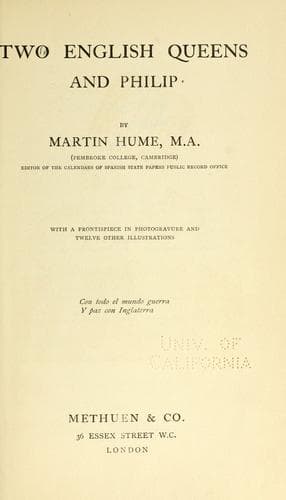
Two English queens and PhilipHume, Martin A. S. (Martin Andrew Sharp)
Philosophy
Two English queens and Philip
Hume, Martin A. S. (Martin Andrew Sharp)
In the meanwhile the conspiracy, by far the most dangerous that Elizabeth
ever had to face, was developing in London. Cecil, who, in fact, was the
most pacific of ministers, is represented by the Spanish party as the
firebrand, determined to precipitate a war with Spain. This was certainly
not the case. He, with his cool head, understood how far he might go now
that Philip was powerless to attack England. The seizure of the money
destined to pay Alba’s troops had made all the difference, and Cecil
and his mistress knew that they might for the present defy Spain with
impunity. The news of the attack upon Hawkins’s expedition at San Juan
de Lua was now confirmed and added to the determination of the English
Protestant party to get even with a Power which, for the time at all
events, was disabled for harm. But the conservative elements, the old
English nobility, with their strong Catholic leanings, their traditions
of awed regard for the alliance of the House of Burgundy and Spain, and
with their long-standing jealousy of Cecil, saw in his present action a
dangerous provocation to a Power they dreaded, and a possible opportunity
of supplanting him and his party in the counsels of the Queen.
On several occasions the nobles of this party had expressed to de Spes
their annoyance at the seizure of the treasure; and we have seen that
the Earl of Northumberland, the powerful Catholic head of the House of
Percy, had sought him out secretly in the dead of night to make disloyal
offers to him. The Duke of Norfolk, unhappily for himself, had also
been drawn into these questionable intrigues by his father-in-law, the
Earl of Arundel. Late in February, 1569, Norfolk and Arundel sent a
Florentine banker in London, one Ridolfi, a great friend of de Spes and
the Pope’s agent in England, to tell the Spanish ambassador that they had
put up with Cecil’s impertinences and violence in seizing the treasure
so far because they were not strong enough to resist him. “But they are
gathering their friends, and letting the public know what is going on,
in the hope and belief that they will be able to turn out the present
accursed Government and raise a Catholic one, bringing the Queen to
consent thereto. They think you [_i.e._, the Duke of Alba] will support
them in this, and that the country will not lose the friendship of our
King.” The object of this conspiracy was to capture (and probably kill)
Cecil; and, although the nobles euphemistically professed to believe
that Elizabeth would consent to a entire revolution in her religion and
policy, it is evident that the intention of the majority was to depose
her in favour of Mary Stuart. On the 2nd April de Spes writes: “The Duke
of Norfolk and the Earl of Arundel wish to serve your Majesty. They have
many friends and adherents in the country, and when they hear that your
Majesty will accept their goodwill, they will declare themselves more
openly at a convenient opportunity. The Duke of Alba ... orders me to
Public-domain text, read in full here on John Shaqi.
Reviews
Reviews
No reviews yet
Be the first to share your thoughts on this work.
Elsewhere in the archive
Join the Discussion
Join the discussion
Sign in to leave a comment or review.
Sign InorCreate an account