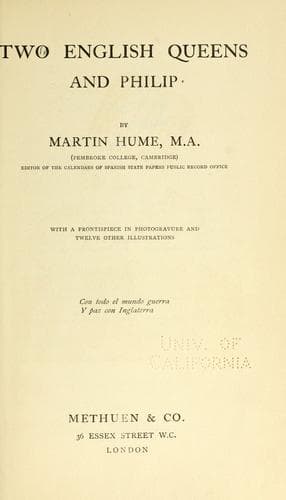
Two English queens and PhilipHume, Martin A. S. (Martin Andrew Sharp)
Philosophy
Two English queens and Philip
Hume, Martin A. S. (Martin Andrew Sharp)
On the 15th October de Spes wrote to the King that approaches were being
made by the French to marry the young Duke of Anjou to Mary, this, of
course, being one of Catharine’s tricks to frustrate the Spanish attempts
to dominate Britain through the Queen of Scots. “It may be,” says de
Spes, “that the Queen [Mary] will consent, but it will not please the
majority of the English people, and it certainly does not please me. The
Catholics are not very much in favour of the marriage with the Duke of
Norfolk, as they are uncertain about his orthodoxy, although Arundel and
Lumley assert that he will be obedient to the Church. His desire to reign
may well lead him from bad paths to good ones. The Duke [of Norfolk]
himself has been very cool about this marriage, but he now seems to wish
to renew the project, particularly as he expects shortly to be quite at
liberty, in accordance with the Queen’s promise to him. If your Majesty’s
wishes are to be represented ... the Bishop of Ross will be a good
negotiator, and I could conduct the matter with him or with Ridolfi, who
has been in communication with them; and if it should be necessary for
the Duke of Norfolk to bind himself separately to other conditions, steps
may be taken at once in the matter. Pray your Majesty send me orders, for
it is certain that the release and marriage of the Queen of Scots carries
with it the tranquillisation of Flanders and the restoration of religion
in this country.”
Philip, in answer to this and many similar hints, had nothing but vague
expressions of sympathy to send in reply, with fresh orders to his
ambassador to follow strictly the instructions of the Duke of Alba. For
months, until the Spanish fleet had passed harmlessly down Channel, the
hollow negotiations between Elizabeth and Mary went on, and a similar
pretence of conferences with regard to the reopening of trade with the
Duke of Alba, whilst Elizabeth checkmated the French advances to Mary
Stuart by herself suddenly displaying a desire to marry the boy Duke of
Anjou. “They think,” wrote de Spes early in February, 1571, “that with
this talk about the marriage of the Queen [Elizabeth] with the Duke
of Anjou we shall be afraid to offend them, and the pirates are more
welcomed than ever, whilst the Queen of Scot’s business is being delayed.
It is true that so far as the Catholics are concerned matters were never
more favourable than now. I did not dare to accept their offers, in the
face of the Duke of Alba’s instructions; but whenever his Majesty wishes,
a great service can be done to God, and at the same time the safety of
the Netherlands secured and the throne of Spain aggrandised. The position
of the King’s ambassador here does not add much to his dignity.... I
have suffered more than can be imagined.”[194] De Spes had his personal
grudge as well as his Catholic zeal now to spur him on to vengeance. The
irresponsiveness of his master and of Alba to the repeated suggestions
Public-domain text, read in full here on John Shaqi.
Reviews
Reviews
No reviews yet
Be the first to share your thoughts on this work.
Elsewhere in the archive
Join the Discussion
Join the discussion
Sign in to leave a comment or review.
Sign InorCreate an account