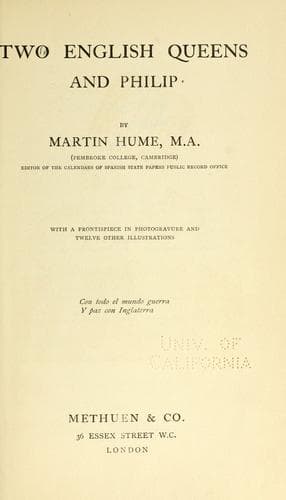
Two English queens and PhilipHume, Martin A. S. (Martin Andrew Sharp)
Philosophy
Two English queens and Philip
Hume, Martin A. S. (Martin Andrew Sharp)
The Huguenots were now in unrestrained power in France, and Elizabeth,
as usual when she was in fear of Spain, was carrying on a desperate
flirtation with the Duke of Anjou, and surpassing herself in her
blandishment to Catharine de Medici. Simultaneously with the expulsion
of de Spes from England, the Spanish ambassador in Paris, Don Francés
de Alava, found France similarly uncongenial to him; for he had been
plotting against the Huguenots as de Spes had plotted against the
Protestants, and had fled in disguise to Flanders, so that Philip
found himself alienated both from England and France at the same time,
a position that always made him uneasy, especially now that not only
a marriage but a national alliance was in full negotiation between
Elizabeth and Catharine.[204] For the next six months the farcical
political courtship of the young Duke of Alençon, the boy brother of
Anjou and the King of France, was carried on furiously by the middle-aged
Queen of England as an antidote for the unappeasable anger of Spain. But
with her usual diplomacy, now that she had worked her will in everything,
Elizabeth thought best not to drive Philip into violent courses against
her. She had seized his million ducats and all the property of his
subjects in England, she had unmasked all his plots, had expelled his
ambassador, flouted his great viceroy Alba, her subjects had harried
Spanish ships on every sea, and helped unchecked the Dutch rebels who
defied him; but she did not wish to go to war with him if she could help
it, especially if she could gain all she wanted without doing so.
When the Spanish ambassador in Paris was about to escape, Walsingham, the
English ambassador, had gone and congratulated him upon the great naval
victory over the Turks in the Mediterranean that King Philip’s brother,
Don Juan, had just gained at Lepanto; and then, after asking many curious
questions about Don Juan, Walsingham had said to Don Francés, as if in
joke, “This sounds like a marriage, does it not?” The Spaniard retorted
in the same tone, “Yes; let you and I manage it together.” With this
opening Walsingham became serious, and enlarged upon Elizabeth’s personal
obligations and liking for her Spanish brother-in-law, and the turpitude
of certain ministers in sowing discord between them. If it were not for
the obstacle of religion, he continued, the marriage hinted at might take
place. It was, of course, mere talk, and was intended to be no more; but
Walsingham spoke with a purpose, and knew that his mistress thought it
time to repair some of the broken ties that held her country to Spain.
Public-domain text, read in full here on John Shaqi.
Reviews
Reviews
No reviews yet
Be the first to share your thoughts on this work.
Elsewhere in the archive
Join the Discussion
Join the discussion
Sign in to leave a comment or review.
Sign InorCreate an account