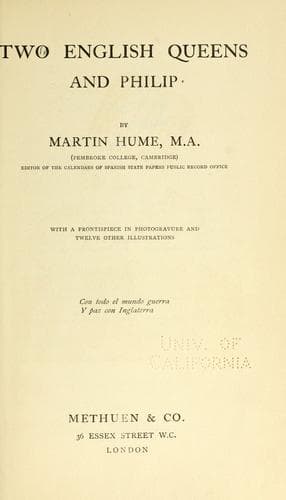
Two English queens and PhilipHume, Martin A. S. (Martin Andrew Sharp)
Philosophy
Two English queens and Philip
Hume, Martin A. S. (Martin Andrew Sharp)
Gradually Guaras, though in somewhat more humble fashion than de Spes,
immersed himself in intrigues on behalf of Spain, many of them doubtless
proposed to him in good faith, but others, as we know now, mere traps set
for him by Lord Burghley’s contrivance, into which he easily fell to his
own ultimate undoing. Several English captains were in close negotiation
with him for months for the betrayal to the Spaniards of Flushing,
Caunfer, and other strong places, for the murder of the Prince of Orange,
and other schemes. But it is evident that these advances through him
were received with doubt and caution by Philip and Alba, who probably
doubted his discretion, for when a group of English captains had to be
finally negotiated with for the capture of Flushing a special envoy, a
merchant seaman named Zubiaur, was sent to England for the purpose with
strict orders that Guaras should know nothing whatever of it; and even
whilst Guaras was acting as _chargé d’affaires_ of Spain a Portuguese spy
(Fogaza) in Spanish pay reported all his movements to the authorities at
Madrid.
By the end of 1573 it was patent to all the world that Alba’s reign
of blood had failed. The stern old chief had been beaten indeed by
Elizabeth’s seizure of the treasure, and he never recovered from the
blow. Forced to raise money somehow, for Philip was bankrupt both in
credit and in means, Alba imposed upon rich Flanders and Brabant the
“tenth penny” that had ruined Castile. Then all the Netherlanders rose.
It was no longer a question of local government or even of faith, but of
moneybags; and Catholic and Protestant alike rebelled against spoliation
and the destruction of Flemish prosperity. Indignant remonstrances
went to Philip, and the Spanish Council even angrily condemned Alba’s
measure. “Neither the heads smitten off nor the privileges abolished have
aroused so much resistance as this,” wrote Alba: but he needed money for
the King’s service, and money he must have. Thus he found himself face
to face, not with a faction in revolt, but with an outraged and united
nation, and through 1572 the grim old Duke stuck to his guns. First he
crushed the south, sweeping the Huguenot auxiliaries aside and submitting
all those who raised the slightest protest to ruthless slaughter.
Public-domain text, read in full here on John Shaqi.
Reviews
Reviews
No reviews yet
Be the first to share your thoughts on this work.
Elsewhere in the archive
Join the Discussion
Join the discussion
Sign in to leave a comment or review.
Sign InorCreate an account