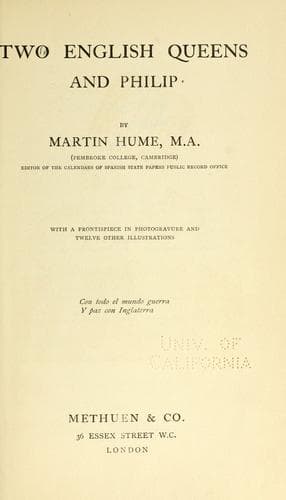
Two English queens and PhilipHume, Martin A. S. (Martin Andrew Sharp)
Philosophy
Two English queens and Philip
Hume, Martin A. S. (Martin Andrew Sharp)
On the 16th March, 1578, Mendoza sat on a low stool by Elizabeth’s side,
under the canopy in the Palace of Greenwich. He was a man already of
mature age, of stately port, strong and masterful as became a dashing
cavalry leader, but he spoke on this occasion, his first formal audience
of Elizabeth, in silken tones, as he tried his best to excuse Don Juan’s
breach of faith with the States. The Queen, on her side, had nothing
but complaints and protests. Her aim was to be made a party to the new
pacification, either as arbitrator or mediator, because, she said, that
she would have to provide the financial guarantee offered by the States.
But it was not Philip’s intention to allow her thus to come between him
and his subjects, and this point was always evaded, cleverly as she
urged it. But upon the main point she and Mendoza soon agreed. If Philip
would make the concessions to the States that he now promised, and they
refused to submit, she herself would help to punish them; and as for the
French, she would take care they were never masters of Flanders, with or
without Don Juan. It was noticed that as soon as the Queen said that she
would help to punish the States if they did not accept the terms promised
by Philip, Leicester hurriedly left the chamber, it was whispered to
write by special courier to Flanders that Havrey should at once return to
England and represent the rebel view of the situation.
“I am glad to see you again,”[224] said the Queen, after the business
talk was finished, “although I have been told that the real object of
your coming is to plan many things to my injury; but even if you were
not a minister of my good brother, I do not think that you would do me
much harm.” Needless to say, Mendoza loudly proclaimed his devotion to
her, and for a time all went harmoniously between them. Alençon from
the frontier sent to Elizabeth lovelorn epistles of devotion, which she
looked at for a time with some distrust, believing that this might be a
trap whereby the French, as a nation, were endeavouring to gain a footing
in Flanders to her prejudice. Of one thing she was quite determined,
namely, that for every Frenchman who entered Flanders an Englishman
should enter too; and to all Mendoza’s remonstrances at the aid in men
and money that constantly flowed over to the Netherlands, Elizabeth
had the answer ready that they went as much in Philip’s interest as her
own, to prevent the country from falling into the hands of the French.
To Orange, whom she constantly upbraided for welcoming French aid, her
scolding reproaches meant little, for, as he said, he cared not whence
came the help by means of which he could fight the Spaniards, and if he
obtained, as he did, forces from Alençon and from Elizabeth too, he was
willing to put up with the Englishwoman’s hard words.
Public-domain text, read in full here on John Shaqi.
Reviews
Reviews
No reviews yet
Be the first to share your thoughts on this work.
Elsewhere in the archive
Join the Discussion
Join the discussion
Sign in to leave a comment or review.
Sign InorCreate an account