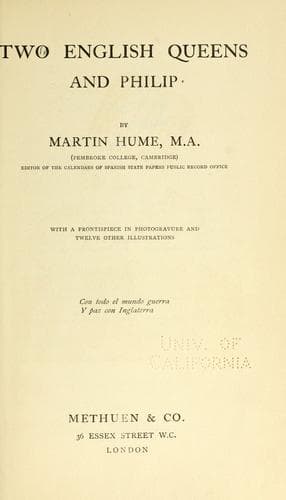
Two English queens and PhilipHume, Martin A. S. (Martin Andrew Sharp)
Philosophy
Two English queens and Philip
Hume, Martin A. S. (Martin Andrew Sharp)
Tassis in Paris was even more despondent, and he feared, what proved to
be true, that the rack would soon draw from the prisoner all he knew.
Time after time Throckmorton was tormented, as were his brother-in-law
and two other relatives, and sufficient was torn from them, together with
the known correspondence, to furnish a good pretext at last for expelling
Mendoza from England with ignominy. On the 19th January, 1584, a formal
summons for him to appear before the Council was handed to him. “If these
gentlemen wish to see me in my private capacity,” he replied to Beal,
the Secretary, “let them come to my house as I went to theirs when I
wanted to see them. But if they are sitting in Council, I would wait upon
them, as an ambassador should; but I warn them that if I open my ears to
what they have to say, I shall not shut my mouth to answer them, as the
service of my master may demand.” He says he gave this answer because he
knew the intention was to expel him, and on the Councillors answering
that they wished to see him officially, he went to the Lord Chancellor’s
house to meet them.
Walsingham spoke Italian better than the rest, and formulated the
Queen’s complaint. Mendoza, he said, had conspired with Guise to liberate
the Queen of Scots; he was known to be in communication with Mary, with
the French plotters, and with Throckmorton, and he must leave the country
within fifteen days. “It is strange,” sneered Mendoza, “that the Queen
should have summoned them and himself for such a trifle as this. What
you tell me are mere dreams, hardly worthy of an answer. These general
accusations are absurd, mainly extorted by the rack, and unsupported by
details.” Very different were the charges he brought against the Queen of
trying to injure his master, King Philip: and he launched out his usual
string of complaints, from the seizure of the Spanish treasure fifteen
years before to the present helping of Don Antonio against his rightful
sovereign. As for his leaving England, that, as his hearers well knew,
would delight him, and he would go the moment his master instructed him
to do so in answer to a despatch sent by the Queen requesting his recall.
The Councillors rose angrily at this and said that nothing of the sort
would be done: he must leave England at once: “and they explained their
past acts with impertinences that I dare not repeat to your Majesty, the
least of them being that I ought to be very thankful that the Queen had
not ordered me to be punished for what I had done.”
Public-domain text, read in full here on John Shaqi.
Reviews
Reviews
No reviews yet
Be the first to share your thoughts on this work.
Elsewhere in the archive
Join the Discussion
Join the discussion
Sign in to leave a comment or review.
Sign InorCreate an account