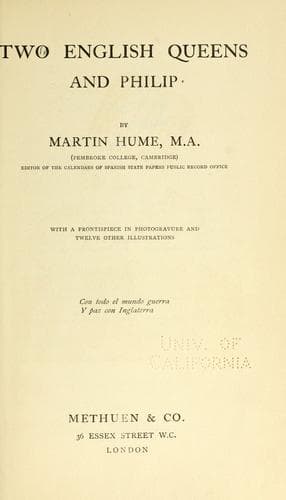
Two English queens and PhilipHume, Martin A. S. (Martin Andrew Sharp)
Philosophy
Two English queens and Philip
Hume, Martin A. S. (Martin Andrew Sharp)
as we shall presently see, with any intention of his personally assuming
the sovereignty after Elizabeth was disposed of.
The question of Mary Stuart’s complicity in Babington’s murder-project is
one that does not directly concern us here, but there can be but little
doubt that, even though it was not conveyed to her in so many words,
she was well aware of the whole plan.[275] At least Mendoza, who should
have known, believed that she was; for on the collapse of the conspiracy
he wrote to Philip: “I am of opinion that the Queen of Scotland must
be well acquainted with the whole affair, to judge by the contents of
a letter she has written to me.... Doubtless it is God’s will to give
England to your Majesty by the strong arm only, since He has allowed so
much Catholic blood to be lost, as will be shed by the discovery of this
business. Nothing has been said yet about my letters, but even if they
were discovered and printed they are so worded that another construction
could be placed upon them.” Mendoza was too sanguine in this respect. His
letters were read and his conversations with the messengers repeated.
There was no need on the part of Elizabeth and Walsingham to go out of
their way to put harmless constructions upon his words, which, indeed,
were plain enough, and a shout of execration went up all over England at
an ambassador who thus connived at the murder of a sovereign and a lady.
Already the alarming reports of spies had aroused the worst fears of
Elizabeth and her people. The Queen, particularly, dreaded the vengeance
which seemed hanging over her. For years she had defied Philip and had
beaten him in the game of diplomacy, depending for her immunity upon the
continued war in the Netherlands and upon Philip’s distrust of France.
But she saw that France could not help her now, whatever her extremity,
for the Guises were in arms and the wretched fribble upon the throne
was but a straw borne hither and thither upon the tempest, whilst the
Huguenots were grimly awaiting the hour when they themselves would
have to fight for freedom and for life. The war in Zeeland, moreover,
was now only maintained by English help, and when the dreaded Spanish
descent upon England was made Elizabeth would have to abandon the Dutch
Protestants to their fate, and the last bulwark of Reform would be
submerged by the flood of Spanish popery.
Public-domain text, read in full here on John Shaqi.
Reviews
Reviews
No reviews yet
Be the first to share your thoughts on this work.
Elsewhere in the archive
Join the Discussion
Join the discussion
Sign in to leave a comment or review.
Sign InorCreate an account