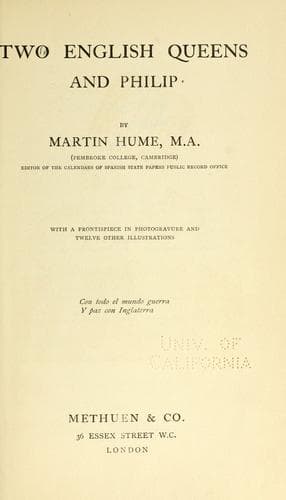
Two English queens and PhilipHume, Martin A. S. (Martin Andrew Sharp)
Philosophy
Two English queens and Philip
Hume, Martin A. S. (Martin Andrew Sharp)
On the day that this was written Philip and Mary and their Court in
state barges rowed from Richmond to Southwark, where they landed at the
Bishop of Winchester’s house, and after killing a fat buck in Southwark
Park, slept at the palace which stood upon the site of the present
London Bridge Station, in order to start betimes in the morning of the
next day across London Bridge, and so through the capital to Whitehall.
All the fifty gibbets in the streets upon which Wyatt’s men had hanged
were cleared away; the heads of the noble malefactors on the spikes at
the Bridge-foot were no longer to be seen. All that paint and gilt and
pageantry and pleasant looks could do to make the dour Londoners think
well of the Queen’s Consort was done. Gog and Magog in new suits stood
at the drawbridge that spanned the space from London Bridge end to the
Southwark shore. Triumphs stood at the street corners, one of the first,
that in Gracechurch Street, containing the maladroit statue of Henry
VIII. with the Bible labelled _Verbum Dei_ in his hand, that so much
moved Bishop Gardiner’s wrath.[62] Past kneeling aldermen and velvet-clad
guildsmen, and with a great train of splendid courtiers, Philip and his
English wife rode through the silent crowds, whilst the guns of the
White Tower thundered what was at the same time a salute to the King
and a warning to the people. The official greetings were, as usual,
extravagantly fulsome. That borne by Gog and Magog is thus translated—
“O Noble Prince, sole hope of Cæsar’s side,
By God appointed all the world to guide,
Right harteley welcome art thou to our land.
The archer Britayne yieldeth thee her hand;
And noble England openeth her bosom
Of hartie affection for to bid thee welcome:
But chiefly London doth her love vouchsafe,
Rejoicing that her Philip has come safe.
She seeith her citizens love thee on each side
And trusts they shall be happy of such a guide,
And al do thinke that thou art sent to their citie
By th’ only means of God’s paternal pitie,
So that their minde, voice, study, power and will,
Is only set to love thee, Philip, still”—[63]
and from Gracechurch to Whitehall tributes in Latin verse even more
eulogistic than this greeted the man whose very presence the great mass
of the people had been taught to dread. All the Philips that ever lived
were dwarfed, he was told, by such a paragon of excellence as himself;
Orpheus had not such power to move as by his eloquence could this
reticent, mumbling Philip, who spoke but little of any language but his
own.
“In like case now, thy grace of speech so franke,
Doth comfort us whose minds afore were bleak
And therefore England giveth thee harty thanke
Whose chiefest joy is to hear thee Philip speke.”[64]
Public-domain text, read in full here on John Shaqi.
Reviews
Reviews
No reviews yet
Be the first to share your thoughts on this work.
Elsewhere in the archive
Join the Discussion
Join the discussion
Sign in to leave a comment or review.
Sign InorCreate an account