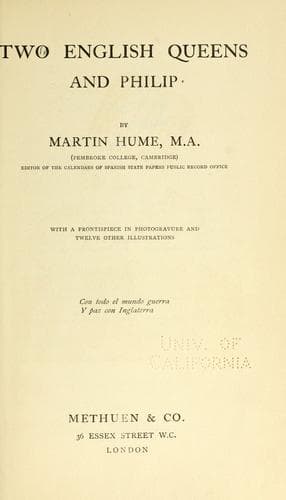
Two English queens and PhilipHume, Martin A. S. (Martin Andrew Sharp)
Philosophy
Two English queens and Philip
Hume, Martin A. S. (Martin Andrew Sharp)
On the 30th April there came flying to London from Hampton Court the
news that the nation’s prayers had been heard, and that at midnight of
the 29th a male child had been born to the Queen, happily and well.
Proclamation was made, joy bells rang, all business was suspended, and
processions from every church perambulated the parishes with psalms
of thanksgiving for so signal a mercy. Public tables were spread that
all might freely eat and drink their fill, whilst bonfires blazed in
broad daylight, and the people forgot for a moment the grim spectre of
persecution that might be perpetuated if the news was true. But it was
not true, and the sad disillusionment came whilst yet the rejoicings were
in full swing. It was, said the Catholics, an invention of the enemy
in order to cause trouble; but though this was possible, for Noailles
had never ceased to sneer at the assurance of the Queen’s condition,
the open and ostentatious preparations for the event that had been
made at Court were of themselves sufficient reason for the rumour of
the birth. The occurrence naturally distressed Mary, who kept her room
thereafter for a time, and at once a flood of scurrilous literature
was surreptitiously circulated in London, calumniating the Queen, her
husband, and all their friends.[94]
All through May the country stood on tiptoe of expectation for the birth
of the prince whose coming meant so much apparently for the future of
Christendom. Mary, still deceiving herself, was comforted by the sight
of new-born babies brought to her whose mothers were, it was said, as
old and as thin as she. Philip’s solicitude, too, knew no bounds. Every
demonstration of affection was lavished upon his wife, and nothing was
allowed to stand in the way of his anticipated joy. Although in deep
mourning for his grandmother, Jane the Crazy, he ordered that the moment
his expected son was born all signs of mourning were to be abandoned.
His father was summoning him incessantly, and he was yearning furiously
to get away, but he could not leave his wife whilst this event was still
pending. At last, at the end of May, he gave permission for most of his
Spanish suite and his guards to cross the Channel in advance of him. It
was indeed time; for only a week before a regular pitched battle between
five hundred armed Englishmen and a body of Spaniards took place at
Hampton Court, many being killed and wounded on both sides;[95] and the
fires of Smithfield were blazing freely now, to the almost open anger of
the people, who unjustly cast all the blame upon the Spanish influence at
Court.
Public-domain text, read in full here on John Shaqi.
Reviews
Reviews
No reviews yet
Be the first to share your thoughts on this work.
Elsewhere in the archive
Join the Discussion
Join the discussion
Sign in to leave a comment or review.
Sign InorCreate an account