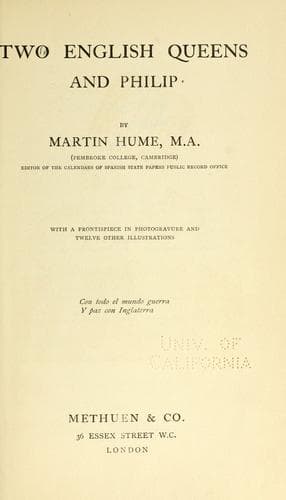
Two English queens and PhilipHume, Martin A. S. (Martin Andrew Sharp)
Philosophy
Two English queens and Philip
Hume, Martin A. S. (Martin Andrew Sharp)
Now, if ever, was the time when the English connection might help Philip,
but it was obvious that unless he could exert his personal influence upon
Mary and her Councillors he could not hope to obtain it. So, at length,
in February, 1557, Philip, sorely pressed though he was, announced to
Mary his intention of visiting her again. The Queen’s joy at the news was
pathetic in its intensity, though Pole warned her not to build too much
upon a promise that had been broken so often before. She had been ill and
disconsolate with hope deferred, but the news of Philip’s coming gave her
new life, and she hurried to London from Hampton Court, visiting Pole at
Lambeth on the way, exerting all her influence to win him to her side.
Thenceforward for some weeks, whilst the King’s voyage was pending, the
English Council sat nearly night and day, and couriers hastened backwards
and forwards between London, Brussels, and Paris. The English refugees
in France had treacherously given to Henry II. much information about
the weakness and disaffection in the English fortresses of Calais and
Guisnes; and at the first news of Philip’s fresh visit to England the
French forces around Calais were increased, for it was evident now that
Mary would be dragged into the war, and her most vulnerable point of
attack was Calais.
Philip landed at Dover on the 18th March, 1557, and took horse with all
speed to Gravesend. At Canterbury he alighted to attend service at the
cathedral; but so hurriedly that he did not wait to take off his spurs.
This being against the rule, a young student was bold enough to claim
the forfeit, or fine: and the King smilingly emptied his purse of gold
in the youth’s cap before he rode on his way. Again his habitual haughty
frigidity was changed for the genial _bonhomie_ that he found suited
his purpose best in England. At every stage messengers from the Queen
met him, one of whom galloped back to her immediately with news of his
progress, and on his arrival at Greenwich poor forlorn Mary hailed him
with love unutterable. For two days he remained with her alone, draining,
as he formerly said, the chalice of his sacrifice to the dregs; and then
they passed through London together once more, she borne in a litter,
he riding by her side. His reception was not unfriendly by the people,
whom he tried to gain by his affability and moderation, though the fear
that war might be the result of his visit made them uneasy. So far as
the Councillors were concerned, they were now but feeble folk to stand
against him and the Queen; though Pole, the Pope’s legate, did not even
officially greet one who was in arms against the Papacy, and the Cardinal
departed as quickly as might be to his diocese, so as to be out of the
way whilst Philip was at Court.
Public-domain text, read in full here on John Shaqi.
Reviews
Reviews
No reviews yet
Be the first to share your thoughts on this work.
Elsewhere in the archive
Join the Discussion
Join the discussion
Sign in to leave a comment or review.
Sign InorCreate an account