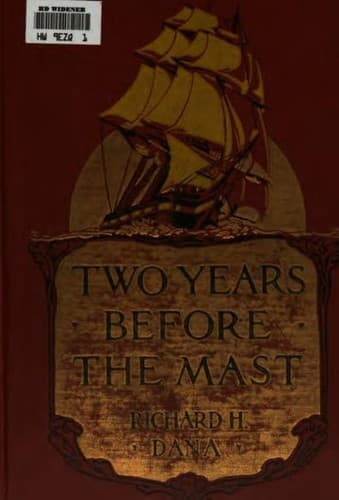
Dana, Richard Henry, 1815-1882; Sailors; Seafaring life; Voyages and travels
Tom Davis knew how to read, write, and cipher in common arithmetic; had
been to the United States, and spoke English quite well. His education
was as good as that of three-quarters of the Yankees in California, and
his manners and principles a good deal better, and he was so quick of
apprehension that he might have been taught navigation, and the
elements of many of the sciences, with the most perfect ease. Old "Mr.
Bingham" spoke very little English--almost none, and neither knew how
to read nor write; but he was the best-hearted old fellow in the world.
He must have been over fifty years of age, and had two of his front
teeth knocked out, which was done by his parents as a sign of grief at
the death of Kamehameha, the great king of the Sandwich Islands. We
used to tell him that he ate Captain Cook, and lost his teeth in that
way. That was the only thing that ever made him angry. He would
always be quite excited at that; and say--"Aole!" (no.) "Me no eat
Captain Cook! Me pikinini--small--so high--no more! My father see
Captain Cook! Me--no!" None of them liked to have anything said about
Captain Cook, for the sailors all believe that he was eaten, and that,
they cannot endure to be taunted with.--"New Zealand Kanaka eat white
man;--Sandwich Island Kanaka--no. Sandwich Island Kanaka ua like pu na
haole--all 'e same a' you!"
Mr. Bingham was a sort of patriarch among them, and was always treated
with great respect, though he had not the education and energy which
gave Mr. Mannini his power over them. I have spent hours in talking
with this old fellow about Kamehameha, the Charlemagne of the Sandwich
Islands; his son and successor Riho Riho, who died in England, and was
brought to Oahu in the frigate Blonde, Captain Lord Byron, and whose
funeral he remembered perfectly; and also about the customs of his
country in his boyhood, and the changes which had been made by the
missionaries. He never would allow that human beings had been eaten
there; and, indeed, it always seemed like an insult to tell so
affectionate, intelligent, and civilized a class of men, that such
barbarities had been practised in their own country within the
recollection of many of them. Certainly, the history of no people on
the globe can show anything like so rapid an advance. I would have
trusted my life and my fortune in the hands of any one of these people;
and certainly had I wished for a favor or act of sacrifice, I would
have gone to them all, in turn, before I should have applied to one of
my own countrymen on the coast, and should have expected to have seen
it done, before my own countrymen had got half through counting the
cost. Their costumes, and manner of treating one another, show a
simple, primitive generosity, which is truly delightful; and which is
often a reproach to our own people. Whatever one has, they all have.
Money, food, clothes, they share with one another; even to the last
piece of tobacco to put in their pipes. I once heard old Mr.
Public-domain text, read in full here on John Shaqi.
Reviews
Reviews
No reviews yet
Be the first to share your thoughts on this work.
Elsewhere in the archive
Join the Discussion
Join the discussion
Sign in to leave a comment or review.
Sign InorCreate an account