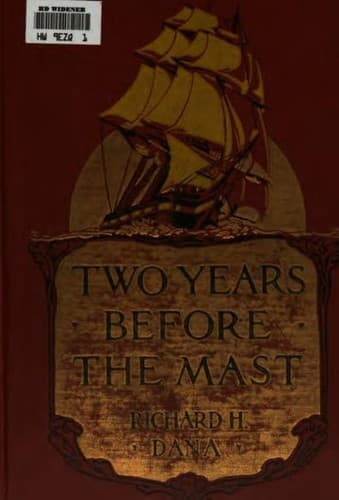
Dana, Richard Henry, 1815-1882; Sailors; Seafaring life; Voyages and travels
This is as much the practice with what at home are called the strictest
denominations as with any others. Indeed, I found individuals, as well
as public bodies, affected in a marked degree by a change of oceans and
by California life. One Sunday afternoon I was surprised at receiving
the card of a man whom I had last known, some fifteen years ago, as a
strict and formal deacon of a Congregational Society in New England.
He was a deacon still, in San Francisco, a leader in all pious works,
devoted to his denomination and to total abstinence,--the same
internally, but externally--what a change! Gone was the downcast eye,
the bated breath, the solemn, non-natural voice, the watchful gait,
stepping as if he felt responsible for the balance of the moral
universe! He walked with a stride, an uplifted open countenance, his
face covered with beard, whiskers, and mustache, his voice strong and
natural;--and, in short, he had put off the New England deacon and
become a human being. In a visit of an hour I learned much from him
about the religious societies, the moral reforms, the
"Dashaways,"--total abstinence societies, which had taken strong hold
on the young and wilder parts of society,--and then of the Vigilance
Committee, of which he was a member, and of more secular points of
interest.
In one of the parlors of the hotel, I saw a man of about sixty years of
age, with his feet bandaged and resting in a chair, whom somebody
addressed by the name of Lies.[1] Lies! thought I, that must be the
man who came across the country from Kentucky to Monterey while we lay
there in the Pilgrim in 1835, and made a passage in the Alert, when he
used to shoot with his rifle bottles hung from the top-gallant
studding-sail-boom-ends. He married the beautiful Doña Rosalía
Vallejo, sister of Don Guadalupe. There were the old high features and
sandy hair. I put my chair beside him, and began conversation, as any
one may do in California. Yes, he was the Mr. Lies; and when I gave my
name he professed at once to remember me, and spoke of my book. I
found that almost--I might perhaps say quite--every American in
California had read it; for when California "broke out," as the phrase
is, in 1848, and so large a portion of the Anglo-Saxon race flocked to
it, there was no book upon California but mine. Many who were on the
coast at the time the book refers to, and afterwards read it, and
remembered the Pilgrim and Alert, thought they also remembered me. But
perhaps more did remember me than I was inclined at first to believe,
for the novelty of a collegian coming out before the mast had drawn
more attention to me than I was aware of at the time.
Public-domain text, read in full here on John Shaqi.
Reviews
Reviews
No reviews yet
Be the first to share your thoughts on this work.
Elsewhere in the archive
Join the Discussion
Join the discussion
Sign in to leave a comment or review.
Sign InorCreate an account