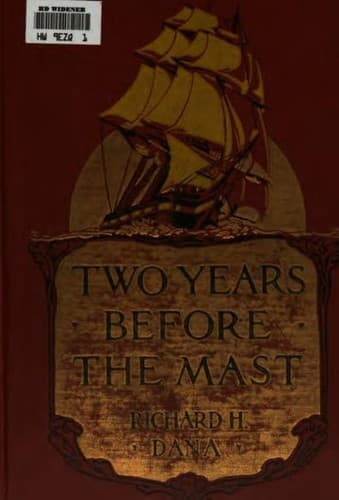
Dana, Richard Henry, 1815-1882; Sailors; Seafaring life; Voyages and travels
We sailed leisurely down the coast before a light fair wind, keeping
the land well aboard, and saw two other missions, looking like blocks
of white plaster, shining in the distance; one of which, situated on
the top of a high hill, was San Juan Campestrano, under which vessels
sometimes come to anchor, in the summer season, and take off hides. The
most distant one was St. Louis Rey, which the third mate said was only
fifteen miles from San Diego. At sunset on the second day, we had a
large and well wooded headland directly before us, behind which lay the
little harbor of San Diego. We were becalmed off this point all night,
but the next morning, which was Saturday, the 14th of March, having a
good breeze, we stood round the point, and hauling our wind, brought
the little harbor, which is rather the outlet of a small river, right
before us. Every one was anxious to get a view of the new place. A
chain of high hills, beginning at the point, (which was on our larboard
hand, coming in,) protected the harbor on the north and west, and ran
off into the interior as far as the eye could reach. On the other
sides, the land was low, and green, but without trees. The entrance is
so narrow as to admit but one vessel at a time, the current swift, and
the channel runs so near to a low stony point that the ship's sides
appeared almost to touch it. There was no town in sight, but on the
smooth sand beach, abreast, and within a cable's length of which three
vessels lay moored, were four large houses, built of rough boards, and
looking like the great barns in which ice is stored on the borders of
the large ponds near Boston; with piles of hides standing round them,
and men in red shirts and large straw hats, walking in and out of the
doors. These were the hide-houses. Of the vessels: one, a short,
clumsy, little hermaphrodite brig, we recognized as our old
acquaintance, the Loriotte; another, with sharp bows and raking masts,
newly painted and tarred, and glittering in the morning sun, with the
blood-red banner and cross of St. George at her peak, was the handsome
Ayacucho. The third was a large ship, with top-gallant-masts housed,
and sails unbent, and looking as rusty and worn as two years'
"hide-droghing" could make her. This was the Lagoda. As we drew near,
carried rapidly along by the current, we overhauled our chain, and
clewed up the topsails. "Let go the anchor!" said the captain but
either there was not chain enough forward of the windlass, or the
anchor went down foul, or we had too much headway on, for it did not
bring us up. "Pay out chain!" shouted the captain; and we gave it to
her; but it would not do. Before the other anchor could be let go, we
drifted down, broadside on, and went smash into the Lagoda. Her crew
were at breakfast in the forecastle, and the cook, seeing us coming,
rushed out of his galley, and called up the officers and men.
Public-domain text, read in full here on John Shaqi.
Reviews
Reviews
No reviews yet
Be the first to share your thoughts on this work.
Elsewhere in the archive
Join the Discussion
Join the discussion
Sign in to leave a comment or review.
Sign InorCreate an account