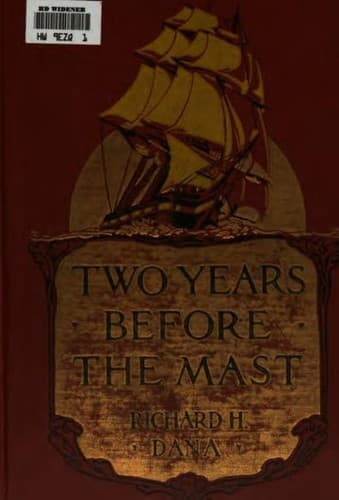
Dana, Richard Henry, 1815-1882; Sailors; Seafaring life; Voyages and travels
Having at length gone through our turns and acquitted ourselves of
all obligations, we slipped out, and went about among the houses,
endeavoring to find horses for the day, so that we might ride
round and see the country. At first we had but little success, all
that we could get out of the lazy fellows, in reply to our
questions, being the eternal drawling Quien sabe? (``Who knows?'')
which is an answer to all questions. After several efforts, we at
length fell in with a little Sandwich Island boy, who belonged to
Captain Wilson, of the Ayacucho, and was well acquainted in the
place; and he, knowing where to go, soon procured us two horses,
ready saddled and bridled, each with a lasso coiled over the
pommel. These we were to have all day, with the privilege of
riding them down to the beach at night, for a dollar, which we had
to pay in advance. Horses are the cheapest thing in California;
very fair ones not being worth more than ten dollars apiece, and
the poorer being often sold for three and four. In taking a day's
ride, you pay for the use of the saddle, and for the labor and
trouble of catching the horses. If you bring the saddle back safe,
they care but little what becomes of the horse. Mounted on our
horses, which were spirited beasts (and which, by the way, in this
country, are always steered in the cavalry fashion, by pressing
the contrary rein against the neck, and not by pulling on the
bit), we started off on a fine run over the country. The first
place we went to was the old ruinous presidio, which stands on a
rising ground near the village, which it overlooks. It is built in
the form of an open square, like all the other presidios, and was
in a most ruinous state, with the exception of one side, in which
the commandant lived, with his family. There were only two guns,
one of which was spiked, and the other had no carriage. Twelve
half-clothed and half-starved looking fellows composed the
garrison; and they, it was said, had not a musket apiece. The
small settlement lay directly below the fort, composed of about
forty dark brown looking huts, or houses, and three or four larger
ones, whitewashed, which belonged to the ``gente de razon.'' This
town is not more than half as large as Monterey, or Santa Barbara,
and has little or no business. From the presidio, we rode off in
the direction of the Mission, which we were told was three miles
distant. The country was rather sandy, and there was nothing for
miles which could be called a tree, but the grass grew green and
rank, there were many bushes and thickets, and the soil is said to
be good. After a pleasant ride of a couple of miles, we saw the
white walls of the Mission, and, fording a small stream, we came
directly before it. The Mission is built of adobe and plastered.
There was something decidedly striking in its appearance: a number
of irregular buildings, connected with one another, and, disposed
in the form of a hollow square, with a church at one end, rising
Public-domain text, read in full here on John Shaqi.
Reviews
Reviews
No reviews yet
Be the first to share your thoughts on this work.
Elsewhere in the archive
Join the Discussion
Join the discussion
Sign in to leave a comment or review.
Sign InorCreate an account