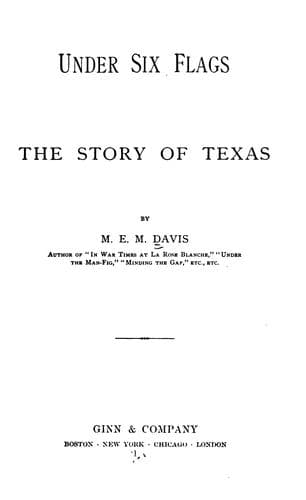
Under Six Flags: The Story of TexasDavis, M. E. M. (Mollie Evelyn Moore)
History
Under Six Flags: The Story of Texas
Davis, M. E. M. (Mollie Evelyn Moore)
Texas -- History
After the surrender General Granger continued to hold military
possession of the state.
Before his arrival Pendleton Murrah, who had succeeded Lubbock in 1863,
had left his office in the hands of the lieutenant-governor Fletcher S.
Stockdale, and gone to Mexico.
Andrew J. Hamilton was appointed provisional governor by President
Johnson. He arrived at Galveston in July (1865), and at once assumed the
duties of his office.
He ordered an election of delegates to a convention which was called for
the purpose of framing a new constitution.
But no man was allowed to vote who had borne arms against the United
States. The majority of Texas men had fought against the Union; they
therefore took little interest in an election of delegates for whom they
could not vote.
The convention met (February, 1866), the new constitution was drawn up
and submitted for ratification to such of the people as were “loyal to
the United States, and none others”; and in June James W. Throckmorton
was elected governor.
A few months later the United States government decided to place the
state again under military rule. Louisiana and Texas were constituted a
Military District with headquarters at New Orleans. General Philip
Sheridan was placed in command, and General Charles Griffin was ordered
to Texas with several thousand troops to enforce military rule (March,
1867). His headquarters were at Galveston.
All elections except those under control of his officers were forbidden
by General Griffin. An oath, known as the “iron-clad oath,” was required
of all voters. The newly freed negroes were for the first time placed on
juries and encouraged to vote.
It was during this time that the remains of the great soldier General
Albert Sidney Johnston were removed from New Orleans to Austin for final
burial.
At Houston, when the funeral train rolled into the station, it was met
by a procession of five hundred ladies and little girls. The coffin was
borne to the old Houston Academy, where for a day and night it lay in
state, amid the mournful tolling of bells.
In July Governor Throckmorton, upon reports made by General Griffin, was
removed from office by General Sheridan, and E. M. Pease appointed in
his place.
[Illustration: General Albert Sidney Johnston.]
In September, 1869, Governor Pease, vexed and wearied by the strife and
discord around him, resigned his thankless office. For a time there was
no governor, a military adjutant performing the duties of the place.
In 1870 Edmund J. Davis was inaugurated governor and held the office
four years. He was succeeded in 1874 by Richard Coke, with Richard B.
Hubbard as lieutenant-governor.
The dark and stormy period from the surrender to the close of Governor
Davis’ term of office has since been known in Texas as the
“Reconstruction Time.”
Public-domain text, read in full here on John Shaqi.
Reviews
Reviews
No reviews yet
Be the first to share your thoughts on this work.
Elsewhere in the archive
Join the Discussion
Join the discussion
Sign in to leave a comment or review.
Sign InorCreate an account