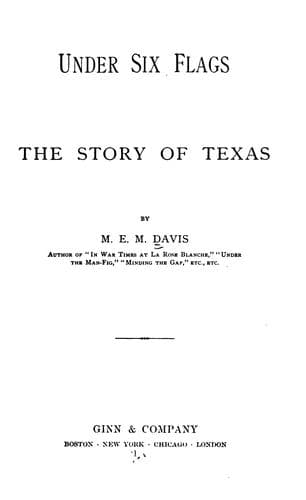
Under Six Flags: The Story of TexasDavis, M. E. M. (Mollie Evelyn Moore)
History
Under Six Flags: The Story of Texas
Davis, M. E. M. (Mollie Evelyn Moore)
Texas -- History
He began his new duties with ardor. But constant anxiety and the
hardships of prison life had left him weak and delicate. The unfinished
room where he worked was without fire; he was seized suddenly with
pneumonia, and after a short illness he died (December 27, 1836).
The Father of Texas was but forty-three years old. His life had been
noble, useful, and unselfish, and his death was a public loss. His body
was conveyed in the steamer _Yellowstone_ to Peach Point on the Brazos,
near Columbia. There, in the presence of the President and his cabinet,
the officers of the army and navy, and a large concourse of citizens, he
was buried with military honors.
[Illustration: Mirabeau B. Lamar.]
The first regular Congress had a hard task before it. The people of
Texas were in favor of annexation to the United States. But a strong
faction in that nation, though willing to acknowledge Texas as an
independent country, was strongly opposed to receiving another slave
state. The young Republic was therefore obliged to stand alone.
There was a large public debt, but no money in the treasury. Mexico
still laid claim to her rebellious province, and it was necessary to
maintain an army to repel invasion, and a navy to defend the coast. The
Indians were troublesome. The civil law, in the confusion and disorder
of the war, had become almost a dead letter.
This was a tangled skein, but Congress set to work with hearty good will
to unravel the threads. The legislature provided for the public debt and
other state expenses by issuing land scrip (government paper entitling
the holder to so many leagues of land).
[Illustration: First Capitol of Texas. At Columbia (1836).]
County and magistrate courts were organized; a Supreme Court was formed,
and the Spanish code of laws was displaced by the code used by the
United States. The soldiers instead of their pay received permission to
go home on long visits to their families. Some vessels were bought for
the navy, and commissioners were sent to the different Indian tribes to
make treaties of friendship.
Congress adjourned in December. The following May it met in the new town
on Buffalo Bayou named in honor of the President.
Public-domain text, read in full here on John Shaqi.
Reviews
Reviews
No reviews yet
Be the first to share your thoughts on this work.
Elsewhere in the archive
Join the Discussion
Join the discussion
Sign in to leave a comment or review.
Sign InorCreate an account